A Kbis, or extrait Kbis, is the official proof that a French company is registered: an extract from the trade and companies register, issued by the greffe, the registry attached to each commercial court. It's often called the company's "identity card", and banks, landlords and suppliers ask for it all the time. If you're setting up or taking over a company in France, you'll be handing yours out; if you do business with a French company, you'll probably receive one. The Kbis is also one of the most forged business documents: in a press release from June 2024, Infogreffe, the body that brings together the commercial court registrars, said the number of Kbis scams had risen "by more than 100%" in 2024 compared with the two previous years combined (Infogreffe). Here's what you need to know to hand yours over wisely, and to avoid being taken in by someone else's.
What exactly is a Kbis?
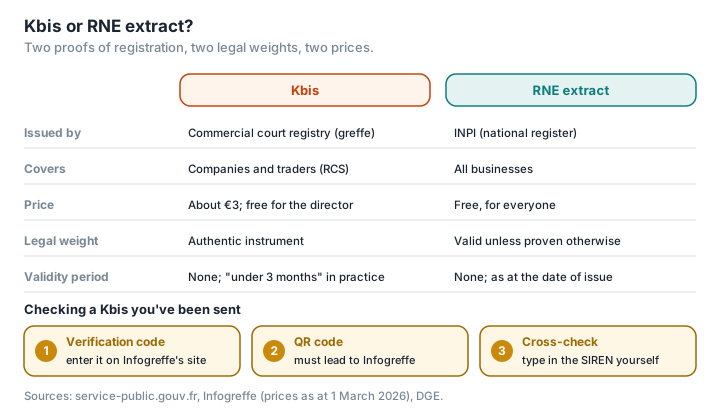
It's an extract from the registre du commerce et des sociétés (RCS), France's trade and companies register. It's issued by the greffe of the commercial court, "which gives it the value of an authentic instrument" (entreprendre.service-public.gouv.fr), a document whose content carries special evidential weight in French law. It only covers companies and traders registered with the RCS: a craftsperson or a self-employed professional trading as a sole trader (entreprise individuelle) doesn't have one.
How much does it cost? About €3: according to Infogreffe's price list updated on 1 March 2026, €2.44 in person at the registry, €3.06 online and €4 by post (Infogreffe); a ministerial answer from April 2026 still quotes the previous, slightly higher prices. The company's director can get it free of charge for their own company through Infogreffe's MonIdenum service, as the government points out in an answer to the French Senate (Senate, MonIdenum). The exception is companies registered in the Bas-Rhin, Haut-Rhin and Moselle départements, in Alsace-Moselle, whose directors have to go to their registry (LegalPlace, which also explains the procedure).
How long is it valid for? It has no legal period of validity. In practice it's "generally valid for 3 months at most", because most recipients insist on a recent extract (LegalPlace). So a letter inviting you to "renew your Kbis" for a fee is a scam.
Is the Kbis still essential?
Less and less. Since 1 November 2021, it's no longer required for 55 administrative procedures: the SIREN, the nine-digit number that identifies every French business, is enough, as the authorities look up the information themselves (Direction générale des entreprises). "For example, it is no longer necessary to provide a Kbis extract to bid for a public contract", the government confirms (Senate).
Above all, there's a free alternative: the extract from the registre national des entreprises (RNE), France's national business register, also called a registration certificate (attestation d'immatriculation). Anyone can download it with the SIREN from data.inpi.fr or the Annuaire des entreprises, the government's public business directory (INPI); the INPI is the French intellectual property office, which keeps the RNE. The extract certifies the information it contains "on the day it is issued and until proven otherwise", and has replaced the Kbis "for many administrative procedures" (entreprendre.service-public.gouv.fr). For your private-sector partners, the RNE extract is "in principle also sufficient", "subject to specific rules", says the DGE, the government directorate for business (DGE).
Who will ask you for one anyway? Your bank may still require it to open an account (see the episode on business bank accounts), as may a commercial landlord. Your business customers, for their part, must check that you're properly registered for any contract worth at least €5,000 excluding VAT, when it's signed and then every six months (Labour Code, art. R8222-1). The law doesn't require them to get a Kbis: a quote or business correspondence showing your company name, full address and RCS number is also enough, alongside the attestation de vigilance from the Urssaf, the body that collects social security contributions (Labour Code, art. D8222-5). The RNE extract is only mentioned there for craft businesses.
What about where you are? In the UK, the closest equivalent is the certificate of incorporation that Companies House issues when a company is registered: it "confirms the company legally exists and shows the company number and date of formation" (GOV.UK). Unlike a Kbis, the register's details cost nothing to check: the Find and update company information service shows, free of charge, a company's registered address, date of incorporation, current and resigned officers and filed documents, and lets you set up free email alerts when a company updates its details (GOV.UK). The same reflex applies as in France: look the company up yourself rather than trusting the PDF you've been sent.
How do you check a Kbis you've been sent?
A genuine Kbis carries, according to Infogreffe, "the unique authentication QR code and the accompanying datamatrix code", "the Marianne watermark" (the emblem of the French Republic), "the registry stamp" and "the registrar's signature" (Infogreffe). These features can be copied, but they make a check possible.
The verification code. At the top right of the Kbis, next to the QR code, there's a ten-character code made up of digits and letters. You enter it on Infogreffe's checking service (controle.infogreffe.fr), or scan the QR code: the page shows the order date, the company name and its registration number, or reports that no document matches the code (Actradis, Once For All). If the QR code leads anywhere other than an Infogreffe domain, be wary: that's the trick described in our article on QR code phishing.
The cross-check. The most reliable check doesn't depend on the document you've received: type the SIREN into the Annuaire des entreprises or data.inpi.fr yourself, and compare the company name, address, directors and share capital. You can also order an up-to-date Kbis yourself for about €3.
The bank details that come with the Kbis. A fake supplier will often send a convincing Kbis along with a fake RIB, the slip with a French bank account's details. The Kbis proves nothing about the bank account: check the details by calling the supplier back on a number you already have, as we explain in Fake PDF invoices.
Why are fake Kbis extracts on the rise?
Because they open doors: credit, equipment hire, a supplier account. In the same press release, Infogreffe states that two thirds of businesses reported at least one fraud attempt, that more than 30% of businesses that fell victim suffered losses of over €10,000, and 15% losses of over €100,000 (Infogreffe). The press release doesn't say how these figures were arrived at.
Two other kinds of fraud target directors themselves:
- fake ordering sites, which sell a Kbis bundled with "costly monthly subscriptions" (Infogreffe). A question in the Senate mentions an entrepreneur in Moselle who was billed €60 five times by a Swiss company (Senate). Infogreffe keeps a list of these sites and letters (Infogreffe);
- company identity theft, where a fraudster files fake minutes of a shareholders' meeting or fake share transfers with the registry to install themselves as a shareholder or manager, and so obtain "genuine fake" Kbis extracts for the company (Village de la Justice). Hence the value of keeping an eye on changes published about your own company.
How should you send your own Kbis?
The information on a Kbis is public. Yet the document itself, signed and stamped, can be useful to someone else: to pose as your company with a supplier, for example. A few good habits:
- ask yourself whether a Kbis is really needed: for an administrative procedure, the SIREN is often enough; for a private partner, the free RNE extract may do;
- watermark the copy: "For opening a supplier account with [name], October 2026". The French government offers a service called FiligraneFacile, which makes a document "unusable for any purpose other than the one stated in the watermark" (INC), and Watermark PDF adds this kind of wording in your browser, without sending the file to a server (see where your PDF files go online). Set the opacity so that the verification code and QR code stay legible, so the recipient can check it's genuine;
- don't alter the content: a Kbis that has been edited, even to hide a piece of information, becomes a forgery.
Glossary
Kbis: an extract from the trade and companies register, issued by the greffe, that proves a commercial company exists.
RCS: registre du commerce et des sociétés, the trade and companies register, kept by the commercial court registries.
RNE extract: an extract from the registre national des entreprises, the national business register; it's free and covers all businesses, including craftspeople and the self-employed professions.
Infogreffe: the economic interest group of commercial court registrars, which distributes Kbis extracts.
Verification code: the ten-character code printed on a Kbis, used to check that it's genuine on Infogreffe's website.
Watermark a Kbis before sending it, without uploading it: PDFKami, in your browser.