
Every company in France must have a registered office, and prove it: the Code de commerce, the French Commercial Code, requires the company to "show that it is entitled to occupy" the premises where its office is located (article L123-11). On the guichet unique, the single online portal for company formalities, the document is called "proof of occupation of the premises": a commercial lease, a domiciliation contract or proof of address (LegalPlace). Domiciliation is the French term for setting up a company's registered office at an address, and by extension for registered office address services. If you're setting up or taking over a company in France, or you're self-employed and based there, this step concerns you. Behind this routine formality lies a less routine question: who holds your identity documents, why, and for how long? Because to provide you with an address, a domiciliation company has to ask you for much more than a signature.
Transparency: LegalPlace, a French legal services company whose guides we cite, itself offers a domiciliation service. This article doesn't compare offers.
Where can a company's registered office be?
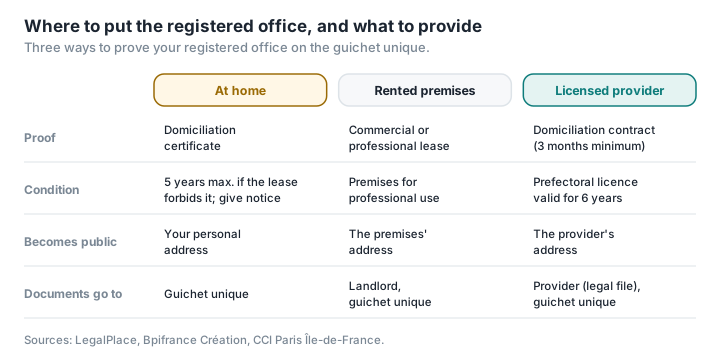
There are three main options.
At home. The director can set up the registered office at their home, unless a legal provision or a contractual clause says otherwise. If the lease or the co-ownership rules (règlement de copropriété) forbid it, article L123-11-1 of the Commercial Code allows it all the same, for no more than five years from the company's formation and no later than the end of the occupation of the premises (the end of the lease, for example), provided the landlord or the building's managing agent (syndic) is notified in writing before the registration application is filed. Before those five years are up, the office has to be moved, or the company will be struck off automatically (Légifrance, LegalPlace). The director then signs a domiciliation certificate (attestation de domiciliation). If you rent, reread your lease before choosing this option. Note that registering the office at home doesn't allow you to receive customers there (CCI Paris Île-de-France, the Paris region's chamber of commerce). A business that receives customers or goods in a home falls outside the framework set by the Construction Code (article L631-7-3) and, depending on the local authority, may need permission to change the use of the property. Finally, the registered office address becomes public on the register.
In rented premises. The commercial or professional lease serves as proof.
With a domiciliation provider (domiciliataire). A domiciliation company provides an address and, often, mail handling. It's the provider that issues the proof, in the form of the domiciliation contract (LegalPlace).
What is a domiciliation provider allowed, and required, to do?
Domiciliation is a regulated activity. The provider must hold a prefectoral licence (agrément préfectoral, issued by the préfet, the State's representative in each département), valid for six years, have premises that it owns or rents under a commercial lease, and a room that guarantees confidentiality (Bpifrance Création, the public bank's guide for business founders). Before signing, check that it's registered on the trade and companies register and has a licence number, advise the CCI Paris Île-de-France and LegalPlace (CCI Paris Île-de-France, LegalPlace).
The contract is in writing, runs for at least three months, renews automatically, and states the licence number (LegalPlace).
Above all, the provider has due diligence obligations. For each company it hosts, it must keep a file of supporting documents, including on the home address and contact details of its director (CCI Paris Île-de-France); inform the greffe, the commercial court registry, when the contract ends or when mail has gone uncollected for three months; send the tax office and the bodies that collect social security contributions a list of the companies it hosts every quarter; and, like banks, apply anti-money laundering rules (Bpifrance Création). Those rules require it to identify its customer, the customer's directors and its beneficial owners, with identity documents to back it up. That's why it asks you for an ID document, proof of address and other papers: it isn't nosiness, it's the law.
Why so many checks?
Because domiciliation can be used to hide a company with no real activity. In its 2025 annual report, Tracfin, the French Finance Ministry's financial intelligence unit, notes that suspicious activity reports from domiciliation companies rose from 120 in 2024 to 225 in 2025, an increase of 88%, for around 3,200 domiciliation companies, and considers the room for improvement "substantial". More broadly, in 2025 it flagged to the registries more than 8,000 companies set up with false documents, one of the hallmarks of short-lived "ephemeral" companies; 80% were struck off (Tracfin). A bill tabled in the French Senate in January 2026 refers to shell or ephemeral companies used for VAT fraud, money laundering and undeclared work (Senate).
Lawmakers are tightening the rules. The law of 25 June 2026 on combating social security and tax fraud (no. 2026-534, art. 69) adds a condition for the licence: proof of training in anti-money laundering, on terms to be set by decree (economie.gouv.fr, CNGTC). And penalties are being handed down: in May 2026, the Commission nationale des sanctions, the body that sanctions breaches of anti-money laundering rules in certain professions, penalised a domiciliation provider for which 28 of the 30 files examined during an inspection by the DGCCRF, the French consumer protection and fraud authority, did not contain the customer's articles of association (Commission nationale des sanctions).
For the honest entrepreneur, the upshot is simple: a reputable domiciliation provider will ask you for documents, and that's a good sign. A provider that asks you for nothing isn't complying with the rules.
What about where you are? In the UK, since 4 March 2024 every company must have an "appropriate address" as its registered office at all times: post sent there must come to the attention of someone acting for the company, and the sender must be able to get confirmation of delivery, so a PO Box is no longer allowed (Companies House, GOV.UK). As in France, the address is public, which is why GOV.UK suggests not using your home if you'd rather keep it private, and using an agent's address instead. A business that provides registered office or business addresses must register for anti-money laundering supervision, with HMRC unless another supervisory body already covers it (GOV.UK).
What should you provide, and how?
The documents usually requested are the director's ID document, recent proof of address, a RIB (the slip giving a French bank account's details), a sworn statement and, once the company is registered, the Kbis, the official extract proving its registration (LegalPlace). The articles of association are also part of the file the provider must keep, as the Commission nationale des sanctions pointed out. A few precautions let you send them without scattering them.
Check the recipient before sending. Licence number, entry on the register: a few minutes of checking are enough to rule out a fake provider collecting ID documents.
Use the provider's secure portal rather than email when it offers one.
Watermark your copies. An ID document marked "For domiciliation contract with [provider], October 2026" loses its value if it's reused elsewhere. Watermark PDF does this in your browser; the French government also offers the online service FiligraneFacile, which processes the file on its servers and then deletes it. We explain why in Watermarking your ID document.
Only provide what's asked for. If proof of address is enough, there's no need to send a full bank statement.
Combine and slim down locally. Front and back of the ID document in a single PDF (JPG to PDF), a lightweight file (Compress PDF): none of this requires sending your documents to an online converter (see where your PDF files go online).
Glossary
Domiciliation: setting up a company's registered office at an address, at home or with a service provider.
Domiciliataire: a company that provides a registered office address to other businesses; it must be licensed by the préfet.
Prefectoral licence (agrément préfectoral): an authorisation issued for six years, required to carry on the business of domiciliation.
Domiciliation certificate (attestation de domiciliation): a sworn statement by the director who sets up the registered office at their home.
LCB-FT: lutte contre le blanchiment de capitaux et le financement du terrorisme, the fight against money laundering and terrorist financing, which imposes due diligence obligations on certain professions.
Tracfin: the French Economy Ministry's financial intelligence unit, which receives suspicious activity reports.
Watermark and combine your documents without uploading them: PDFKami, in your browser.