A company generates paperwork from the day it's born: its statuts (articles of association), the certificate confirming the share capital has been deposited, the annonce légale (the formation notice published in a legal-notices journal), the Kbis (the official extract from the French trade and companies register), then invoices, statements, contracts and minutes. Each has its own retention period, set by a different law. This article is about companies set up in France: it concerns you if you've formed or taken over a French company, or work as a self-employed professional based in France. The simplest rule to remember is also the longest: ten years for the accounts and the invoices. But keeping things for ten years isn't enough: you have to be able to find them, and to prove they haven't been altered.
How long should you keep each document?
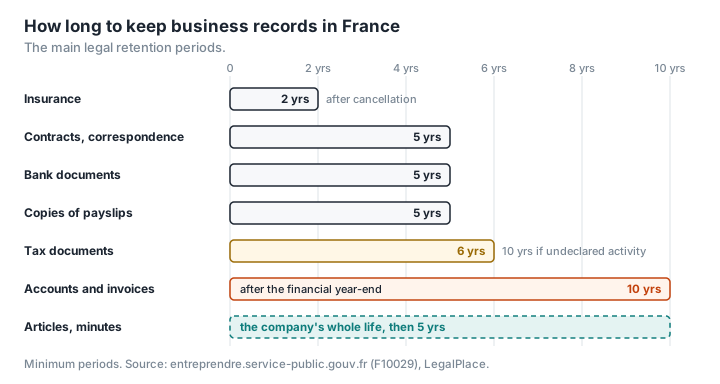
The French administration publishes a table of retention periods (entreprendre.service-public.gouv.fr), which LegalPlace, a French legal-services platform, also sets out (LegalPlace). In short:
| Document | Period | Starting from | Law |
|---|---|---|---|
| Accounting books, annual accounts, supporting documents (including invoices) | 10 years | End of the financial year | Code de commerce (Commercial Code), art. L123-22 |
| Tax documents (corporation tax, income tax, VAT, CFE…) | 6 years (10 for undeclared activity) | Last transaction recorded, or date the document was drawn up | Livre des procédures fiscales (Tax Procedures Code), art. L102 B |
| Contracts and business correspondence | 5 years | — | Code de commerce, art. L110-4 |
| Bank documents | 5 years | — | — |
| Company statuts and amending deeds | 5 years | Removal of the company from the register | Code civil (Civil Code), art. 2224 |
| Register of minutes of general meetings, share registers | 5 years | When they stop being used | — |
| Attendance sheets, proxies, management reports | Last 3 financial years | — | — |
| Copies of payslips | 5 years | — | Code du travail (Labour Code), art. L3243-4 |
| Single staff register | 5 years | Employee's departure | Code du travail, art. R1221-26 |
| Insurance policies | 2 years | Cancellation | Code des assurances (Insurance Code), art. L114-1 |
The CFE (cotisation foncière des entreprises) is a local business property tax. In practice, many businesses keep everything for ten years, to line up with the longest period. For the statuts and the minutes, the clock only starts when the company ends or when they stop being used: so they're kept for the company's whole life, and beyond. These periods are minimums; service-public points out that you can keep documents for longer, except for those that contain personal data.
What about where you are? In the UK, a limited company must keep its company and accounting records for 6 years from the end of the last financial year they relate to, and for longer in some cases: a transaction spanning several accounting periods, equipment expected to last more than 6 years, a late Company Tax Return, or a compliance check opened by HMRC, the UK tax authority (GOV.UK). Sole traders must keep their records for at least 5 years after the 31 January Self Assessment filing deadline for the tax year concerned (GOV.UK).
Can you scan your paper invoices and throw away the originals?
Yes, since 2017, subject to conditions. The amending finance act for 2016 changed article L102 B of the Tax Procedures Code, and a ministerial order of 22 March 2017, in force since 31 March 2017, set out how it works (Legifiscal, Légifrance). An invoice received on paper may then be kept in digital form only, provided the copy is "identical to the original in image and content", in the words of the BOFiP, the French tax authority's official guidance (BOFiP):
- no retouching: image processing is forbidden, and any compression must be lossless;
- colours reproduced exactly where they carry meaning (a signature, a handwritten note, a coloured stamp);
- a PDF or PDF/A-3 file;
- a server seal, a digital fingerprint or an electronic signature, whichever you prefer;
- a timestamp, at the very least from an internal timestamping source;
- a documented organisation, with internal checks, that guarantees the files remain available, readable and intact for the whole retention period.
In other words, a quick phone scan dropped into a folder doesn't meet these conditions. Accounting software and archiving services offering "numérisation à valeur probante" (scanning with evidential value) add the fingerprint and the timestamp, and document the procedure.
Outside the tax sphere, in a dispute, the French Civil Code gives a "reliable copy" the same evidential weight as the original (article 1379). A decree of 5 December 2016 specifies when a digital copy is presumed reliable: a fingerprint that makes any alteration detectable, storage protected from tampering, traceability (Légifrance). The judge remains free to assess it, and may ask for the original if it still exists.
PDF/A, often mentioned, is an archiving format: it guarantees the document will display the same way in twenty years' time. It doesn't stop the file being modified; it's the fingerprint or the signature that reveals a modification. For scanned invoices, PDF/A-3 is an option, not a requirement. We look at this format in detail in PDF/A: what it is, and who really requires it.
Where can you store your archives?
The rule depends on the form (BOFiP):
- paper invoices must be stored in France;
- electronic invoices may be stored in France, in another EU member state, or in a non-EU country that has an administrative assistance agreement with France or that allows immediate online access to the data;
- storage outside France must be declared to the service des impôts des entreprises, the business tax office.
Some sources claim electronic documents "must" be stored in France: that's not what current tax guidance says.
What about the e-invoicing platform? Many approved platforms offer archiving, but the obligation to keep invoices remains the business's own. LegalPlace advises checking how long the archiving lasts and the terms for getting your history back, particularly if you switch provider (LegalPlace). An electronic invoice is kept in its original format, with its structured data: a provider that closes down or gets hacked doesn't excuse you from producing it during a tax audit. The rules for the invoice itself are covered in Your first invoice in France.
How do you avoid losing everything?
Ten years is longer than a laptop lasts, and sometimes longer than a provider does. Ransomware is the most feared scenario: "any organisation can suffer an opportunistic or targeted attack by a cybercriminal group", warns ANSSI, France's national cybersecurity agency, in its guide to backups (ANSSI). The common-sense rule, often called "3-2-1": three copies, on two different media, one of them offline or off-site. And a backup is only worth anything if you've already checked you can restore it.
A few habits for a small business's files:
- One folder per year, then by type: sales, purchases, bank, legal, payroll.
- A meaningful file name:
2026-10-15_invoice_F2026-042_client.pdfturns up in ten seconds,scan0042.pdfin ten minutes. - One complete PDF per document: a three-page invoice scanned into three files gets lost. Merge PDF and Organise PDF bring the pages together and put them back in order. Do this before the timestamp and the fingerprint are applied: any later change invalidates them.
- Lighter files, so that ten years of archives fit on a sensible amount of storage: Compress PDF, checking the text stays legible. For a scanned invoice meant to replace the original, only the "Light" level will do: the "Medium" and "Strong" levels convert pages into JPEG images, a lossy compression that the tax rules exclude. And an electronic invoice you receive should be kept as it is, untouched.
- Legal documents kept separately: statuts, minutes, formality certificates and the Kbis make up the company's permanent file, to be kept for its whole life. What they give away when you send them is the subject of Articles and minutes: what your PDF reveals.
These tools run in your browser, without uploading your archives; we explain why that matters in Where do your files go when you use an online PDF converter?. They're no substitute for an archiving service with evidential value: PDFKami adds no timestamp, fingerprint, seal or electronic signature.
Glossary
Retention period: the time during which a document must be available to produce in a tax audit or a dispute.
Reliable copy (copie fiable): a copy with the same evidential weight as the original; a digital copy is presumed reliable if it meets the technical conditions of the decree of 5 December 2016.
Timestamp: a record of the date and time at which a file existed in a given form.
Digital fingerprint (hash): a short string of characters calculated from a file; the slightest change to the file alters it.
PDF/A: a version of PDF designed for long-term archiving, which guarantees the document displays identically over time.
Ransomware: malicious software that encrypts a victim's files and demands a ransom.
Gather and slim down your archives without sending them anywhere: PDFKami, in your browser.