Opening a bank account for your business can feel like an interrogation: ID, proof of address, articles of association, an extract from the company register, a list of shareholders, sometimes a video of yourself holding up your identity card. Is all of it really necessary? Mostly, yes: most of these demands don't come from the banks themselves; the law imposes them. This article covers the rules in France: it's for you if you're setting up or taking over a company there, working as a self-employed person based in France, or opening an account with a French bank for a French business. Knowing the rules tells you what you can refuse, and how to send what you can't.
Is a business bank account compulsory?
For a company, an account is essential from day one: cash contributions to the share capital have to be paid into a blocked account, with a bank or a notaire (a French public notary), and at least 20% of the capital in a SARL, or 50% in a SAS, has to be paid up (the SARL and the SAS are France's two most common forms of limited company). The funds are released after registration, on presentation of the Kbis, the official extract from the company register that serves as the company's proof of existence (LegalPlace).
For a micro-entrepreneur, France's simplified sole-trader regime, an account dedicated to the business becomes compulsory once turnover exceeds €10,000 for two consecutive years; it can simply be a separate personal account (entreprendre.service-public.gouv.fr). The same page says that for a commercial activity, a dedicated account is compulsory from the start, whatever the turnover.
What about where you are? In the UK, GOV.UK says a limited company's banking "must be separate from your personal banking", and that the simplest way to do this is to open a business bank account; sole traders and ordinary partnerships, by contrast, aren't legally required to have one (GOV.UK, Business.gov.uk). The paperwork has the same origin as in France: under the Money Laundering Regulations 2017, banks "must identify their customers and, where applicable, their beneficial owners, and then verify their identities", and if they can't, they must not open the account (FCA).
Why does the bank ask for so many documents?
Because the French Monetary and Financial Code (notably articles L. 561-5 and R. 561-5-1) requires it to identify its customer and verify that identity before entering into a business relationship, as part of the fight against money laundering. The ACPR, the authority that supervises French banks, has set out these obligations in guidelines (ACPR):
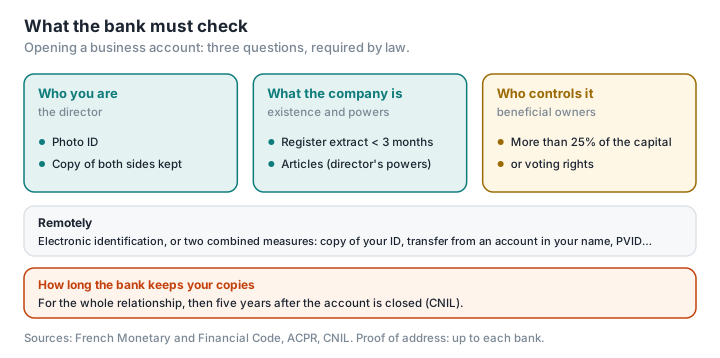
- for the director, a valid official identity document with a photo; in a branch, the bank must make a copy of both sides;
- for the company, an extract from the register less than three months old, which the bank can also obtain itself from the greffe (the commercial court registry) or from DataInpi, the open database of INPI, France's intellectual property office, which runs the national business register; and the articles of association, to check the powers of the person opening the account; a Kbis can be enough when the director's title shown on it says what powers they hold;
- for the beneficial owners, meaning the people who hold more than 25% of the capital or voting rights, their identification; the official register of beneficial owners is a big help, but the bank has to carry out its own checks.
Proof of address, on the other hand, isn't required by law. The ACPR writes that collecting it "is therefore not essential": each bank decides, on the basis of its own risk assessment, whether to ask for it and in what form. In practice, many do. LegalPlace, a French legal-services platform, sums up the usual list: ID for the legal representative, proof less than three months old of the registered office or business address, a Kbis (or, for a micro-enterprise, the SIRET number, the identifier of each business establishment) and signed articles of association for a company (LegalPlace). On the registered office, see also our article on domiciliation.
How long does the bank keep your documents?
A long time. CNIL, the French data protection authority, confirms that a bank may copy your identity document, and must keep it "for five years from the closure of the accounts or the end of the relationship" (CNIL). In other words, every bank where you've opened an account keeps a copy of your documents for the whole relationship, then for five more years. All the more reason not to apply to several banks "just to see".
What about online banks?
They have the same obligations, but carried out remotely. The Monetary and Financial Code, as detailed by the ACPR, allows either an electronic identification method of a sufficient level, or at least two combined measures from a list: for example a copy of your ID, a first transfer from an account in your name in the European Union, or the use of a remote identity verification provider certified by ANSSI, France's national cybersecurity agency. It's that provider who runs the familiar video where you turn your card in front of the camera (ACPR, ANSSI).
Going digital has a downside. Asked about fake rental listings, which harvest applicants' files, the French government acknowledged in 2024 that accounts opened with payment institutions "may have been created using identity documents stolen from previous victims" (Assemblée nationale). Copies of your ID have a market value.
What if a bank refuses to open an account?
Any business domiciled in France that has no deposit account in France is entitled to one. After a refusal, or if a request has gone unanswered for fifteen days, you can apply to the Banque de France, France's central bank, which designates a bank; that bank must open the account within three working days of receiving the documents it asks for, with basic banking services free of charge (La finance pour tous).
How do you send your documents safely?
Use the bank's own channel. The bank's app or secure area is better than email, which leaves copies in several mailboxes and on several servers. This isn't a written rule, just common sense.
Make sure it really is your bank. A fake adviser asking you by email to "complete your file" is a classic. Cybermalveillance.gouv.fr, the French government's support service for victims of cybercrime, recommends only sending your identity documents to people or organisations you have "authenticated with certainty" (Cybermalveillance.gouv.fr).
Prepare clean, complete files. Both sides of your ID in a single PDF, legible and in date: an expired or blurred document will be rejected. JPG to PDF and Compress PDF do this in your browser, without uploading your files to a server (why that matters).
Remove what isn't asked for. A proof of address that runs to several pages can be cut down to the page with your name and address using Delete pages.
A watermark? Cybermalveillance.gouv.fr advises marking the copies you send with the purpose, the date and the recipient, and no official rule forbids doing so for a bank. With Watermark PDF, place it so that it covers neither the photo, nor the document number, nor the machine-readable zone: an illegible ID will get the application rejected. See also why you should watermark your ID card.
Glossary
KYC (Know Your Customer): all the checks a bank has to carry out on its customers' identity.
ACPR (Autorité de contrôle prudentiel et de résolution): the authority attached to the Banque de France that supervises banks and insurers.
Beneficial owner: a person who holds more than 25% of a company's capital or voting rights, or who controls it.
PVID (prestataire de vérification d'identité à distance): a remote identity verification provider, certified by ANSSI.
Droit au compte (right to an account): the procedure for getting an account opened by a bank designated by the Banque de France.
Prepare your documents without sending them to anyone else: PDFKami, in your browser.