
Setting up a company in France is, first and foremost, a matter of producing, gathering and sending documents. A great many documents. In 2024, 1.3 million company-creation filings were made on the guichet unique, the single online portal through which every French business formality now passes, and 5.2 million filings of all kinds had gone through it since it opened on 1 January 2023, according to a government answer published in June 2025 (Assemblée nationale). Each of them set identity documents, proofs of address, signed articles of association and bank certificates in circulation.
This series follows those papers from the moment they are created to the moment they are archived. It is written for anyone dealing with a French company from the inside or the outside: if you are setting up or taking over a company in France, working as a self-employed person based there, or a supplier or client who has been sent a Kbis and wants to know what it is worth. At each step, it answers three questions: what do you have to provide, to whom, and what becomes public? It relies first on official sources and on the guides published by LegalPlace, a French provider of online legal services, without recommending any provider.
What does the process look like, step by step?
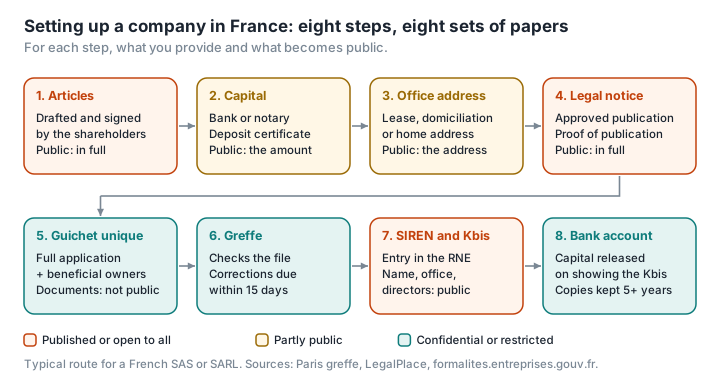
For a company (a SAS or SASU, France's flexible simplified joint-stock company, with several shareholders or just one; or a SARL or EURL, the private limited company, with several partners or just one), the route is almost always the same (LegalPlace, Paris greffe):
- Draft and sign the articles of association (statuts), which set out how the company works.
- Deposit the share capital with a bank or a notary, in a blocked account, and obtain the certificate of deposit of funds (LegalPlace).
- Prove the registered office address: a lease, a domiciliation contract with a business address provider, or proof of the director's home address.
- Publish a legal notice (annonce légale) in a newspaper or online press service approved to carry legal notices, and obtain proof of publication (LegalPlace).
- File the application on the guichet unique, together with the declaration of beneficial owners.
- Wait for the greffe to approve it: the greffe, the commercial court registry, checks the file and may ask for corrections; if you don't respond within fifteen days, the filing is automatically rejected (formalites.entreprises.gouv.fr).
- Receive the SIREN number and the Kbis, the proof that the company exists.
- Release the capital on presentation of the Kbis, usually into the business bank account.
For a micro-entreprise, France's simplified regime for sole traders, the route is shorter: no articles and no capital, just a declaration on the guichet unique with an identity document, proof of address and sworn statements (LegalPlace).
Then come the papers of everyday business life: invoices from the very first client, and keeping all of it on file for years.
What becomes public?
More than you might think. The purpose of the RNE, the national business register, is to inform third parties, and it is free to consult: "Anyone can consult the public data of the national business register online, free of charge" (LegalPlace).
- From registration onwards: the company name, the SIREN, the registered office address, the date of creation, the business activity and the names of the directors. If the registered office is at the director's home, their personal address becomes public.
- With a free account on data.inpi.fr, the open-data site of INPI, the French intellectual property office that runs the register: the articles of association and other filed documents, exactly as they were lodged with the register, including the image of signatures where they were scanned (economie.gouv.fr).
- In the legal notice: the company name, the capital, the registered office, the business purpose and the directors.
Other documents remain confidential or restricted: the identity document, the certificate of deposit of funds, the proof of address; and, since a November 2022 ruling of the Court of Justice of the European Union, information on beneficial owners is no longer open to everyone. Directors can also ask, since the decree of 22 August 2025, for their personal address to be masked in filed documents, as we explain in the episode on articles of association.
What about where you are? In the UK, a limited company is usually registered online with Companies House, for £100 and typically within 24 hours, and every director must first verify their identity, once, through GOV.UK One Login to get a Companies House personal code (GOV.UK). The register is free to search: a director's name, nationality, month and year of birth and service address are public, while their home address and full date of birth are kept on a private register (GOV.UK).
Where do your personal documents go?
To several recipients, all of whom have good reasons to ask for them, and all of whom keep them:
- the guichet unique and the greffe, which receive the whole application;
- the bank, which must verify your identity and keep a copy of your documents for the whole of the relationship, then for five years after the accounts are closed (CNIL), the CNIL being France's data protection authority;
- the domiciliation provider, if you use one, which is required by law to keep a file on every company it hosts;
- the legal notice publisher, the notary or the chartered accountant, depending on the case;
- and, all too often, intermediaries nobody needs: the online converter used to turn a photo into a PDF, the compression site used to get under 10 MB, the email service that keeps every attachment. We have looked in detail at where the files you hand to these sites end up.
Every extra copy is a copy that can leak. Stolen identity documents are used, among other things, to open accounts in the victims' names (Assemblée nationale).
The episodes in the series
- Setting up a company in France: the paperwork (you are here): the full route, from drafting the articles of association to the archives.
- Articles of association and minutes: what your PDF reveals once it's filed in France: revisions, comments, properties and scanned signatures, made public along with the document.
- France's guichet unique: preparing a company filing that won't be rejected: PDF only, 10 MB per file, required documents, grounds for rejection and the deadline for corrections.
- Kbis extract: who can ask you for one, and how to spot a fake: what it proves, the free RNE extract, the verification code.
- After registration, the fake letters: fake INPI notices, fake registers, paid directories.
- Registered office in France: proof of address, what to hand over and to whom: the three options, the provider's obligations, the documents to supply.
- Opening a business bank account in France without sending everything: what the bank must check, and how long it keeps your documents.
- Invoicing your first client in France: mandatory details, payment terms, and what changes in 2027: mandatory details, payment terms, and e-invoicing.
- Keeping your business records in France: what, for how long, and in what form: retention periods, digitisation, storage and backups.
Which habits should you keep throughout?
Three principles come up in every episode.
Provide only what is asked for. The French Ministry of the Economy recommends it for online services: give "only the personal information that is strictly necessary" (economie.gouv.fr). A free RNE extract is often enough where you would have sent a Kbis; one page of a statement is enough where you would have sent the whole thing.
Check who you are sending to. New registrations attract bogus organisations. Before sending anything or paying, type the address of the official website yourself, and check a domiciliation provider's approval or a bank adviser's identity.
Prepare your files yourself. Turning a photo into a PDF, combining the front and back of a document, compressing a scan, watermarking a copy, redacting a document (which also strips its metadata): none of this requires sending your documents to an online service. PDFKami's tools do it in the browser, without sending the files to a server: JPG to PDF, Merge PDF, Compress PDF, Watermark PDF, Redact PDF. They are no substitute for the guichet unique, a legal professional or an archiving service with evidential value.
Glossary
Guichet unique: the official website, run by INPI, through which all French business formalities have passed since 2023.
RNE: registre national des entreprises, the national business register, which centralises information on every French business.
SIREN: the nine-digit number that identifies a French business, assigned by Insee, the national statistics institute.
Kbis: an extract from the trade and companies register (RCS), issued by the greffe; the usual proof that a French company exists.
Legal notice (annonce légale): a notice published in an approved newspaper or online press service, informing third parties that a company has been created or changed.
Beneficial owner: a person who holds more than 25% of a company's capital or voting rights, or who controls it.
Prepare your documents without sending them to a third party: PDFKami, in your browser.