Your first invoice often goes out before everything is in place: the Kbis (the French company registration extract) hasn't arrived, you haven't picked any software, and you open a template in Word or Canva. That's legal, as long as you leave nothing out. An invoice isn't just a commercial document: it's an accounting record, with mandatory details, a fine for each omission, and a format that is about to change. This article covers invoicing in France: it's for anyone who has set up or taken over a company there, a self-employed person based in France, or a foreign client wondering why a French supplier's invoice carries so many mentions.
What must the invoice show?
The French administration publishes the list (entreprendre.service-public.gouv.fr), and LegalPlace, a French legal-services platform, goes through it in detail (LegalPlace). The main items:
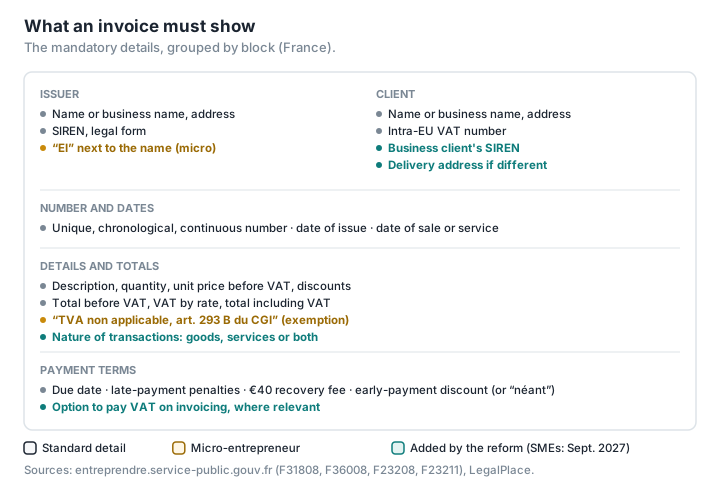
- the date of issue and the date of the sale or service;
- a number that is "unique to each invoice, based on a chronological and continuous sequence": no gaps, no going backwards, no reused numbers;
- your identity: business name or your own name, address, SIREN (the nine-digit number that identifies every French business) and legal form (SAS, SARL and so on);
- your client's identity, with their intra-EU VAT number if they have one;
- the details of the goods or services, unit prices, discounts, and totals before and after tax;
- the payment date, the late-payment penalty rate and the €40 fixed fee for recovery costs, for business clients;
- early-payment discount: if there isn't one, the wording "Escompte pour paiement anticipé : néant" (no discount for early payment) (entreprendre.service-public.gouv.fr).
The e-invoicing reform adds four more: the business client's SIREN, the delivery address if it's different, the nature of the transactions (goods, services or both) and, where relevant, the option to pay VAT on invoicing rather than on receipt of payment (TVA d'après les débits). According to the administration, they become compulsory for SMEs and micro-businesses from 1 September 2027 (entreprendre.service-public.gouv.fr); nothing stops you adding them now.
What about a micro-entrepreneur?
The micro-entrepreneur (France's simplified self-employed status, formerly auto-entrepreneur) has three details to watch in particular (entreprendre.service-public.gouv.fr):
- "Entrepreneur individuel" or "EI" (sole trader), immediately before or after their name, as for any sole trader;
- their SIREN;
- the VAT exemption wording, if they qualify for the small-business VAT exemption: "TVA non applicable, art. 293 B du CGI" (VAT not applicable, Article 293 B of the French General Tax Code). France's VAT rules move from the General Tax Code to a new code, the CIBS (code des impositions sur les biens et services), from 1 January 2027, but references to the old code remain acceptable on invoices until 30 June 2028 (BOFiP). There's no need to rush to change the wording (the service-public page, which predates the postponement, still gives other dates).
If your registration isn't complete, you can write "SIRET en cours d'attribution" (SIRET being allocated; the SIRET is the SIREN plus a five-digit establishment code). LegalPlace warns that "there is no official 'provisional SIRET'", and that "invoicing for an undeclared activity amounts to undeclared work" (LegalPlace).
What payment terms apply?
"As a rule, the payment period is 30 days from receipt of the goods"; the parties can agree on a longer period, but no more than 60 days from the invoice date or 45 days end of month (entreprendre.service-public.gouv.fr).
If a client pays late, penalties are due without any reminder. The rate can't be lower than three times the French statutory interest rate; if the invoice says nothing else, it's the European Central Bank rate plus 10 points, which comes to 12.40% for the second half of 2026. The €40 fixed fee comes on top, once per invoice (entreprendre.service-public.gouv.fr). These rules apply between businesses.
Do you need a quote?
Not as a general rule: "providing a quote is therefore not compulsory" outside the cases set out in the law (entreprendre.service-public.gouv.fr). It is compulsory, for example, for call-out and repair work on buildings and household equipment, for removals, and for personal services at home from €100 including VAT a month (entreprendre.service-public.gouv.fr). Even when it's optional, a signed quote heads off plenty of disputes.
What happens if you get it wrong?
"A fine of €15 is applied for each omission or inaccuracy", capped at a quarter of the invoice amount (entreprendre.service-public.gouv.fr). Not issuing an invoice at all costs far more: up to €75,000 for a sole trader and €375,000 for a company. LegalPlace adds that "for a repeat offence within two years, the administrative fine can be doubled", and that an irregular invoice can cost the client their right to deduct VAT (LegalPlace). On the client's side, paying a business late exposes it to an administrative fine of up to €75,000 for a sole trader and €2 million for a company (entreprendre.service-public.gouv.fr).
What about where you are? In the UK, an invoice from a business that isn't VAT-registered must still show a unique number, your name and address, the customer's name and address, a description of what you're charging for, the supply and invoice dates and the total owed; a limited company uses its full name as it appears on its certificate of incorporation (GOV.UK). Once VAT-registered, you must normally issue a VAT invoice within 30 days of the supply, with a sequential number, your VAT registration number and the VAT rate and amount, and a simplified invoice is allowed only up to £250 including VAT (GOV.UK). All VAT-registered businesses now keep their records and file their returns under Making Tax Digital for VAT (GOV.UK), and the government has announced mandatory e-invoicing for all VAT invoices from 2029, which smaller businesses that aren't required to register for VAT, and choose not to, won't have to adopt (GOV.UK).
Is a PDF invoice still enough?
Yes, until 31 August 2027 for SMEs and micro-businesses. The official timetable is as follows (entreprendre.service-public.gouv.fr, LegalPlace):
- since 1 September 2026, every business liable for VAT in France must be able to receive electronic invoices, through an approved platform; large and mid-sized companies must also issue them;
- from 1 September 2027, SMEs and micro-businesses must in turn issue their invoices electronically.
The obligation covers invoices between businesses; sales to consumers fall under e-reporting, a transmission of data to the tax authority.
An electronic invoice, in the sense of the reform, isn't a PDF sent by email: it's a structured, machine-readable file (Factur-X, UBL or CII) that goes through an approved platform. Factur-X looks like a PDF, but it carries the invoice data in a form software can use. We go through this timetable in France's e-invoicing reform: is your PDF invoice still valid?. There is no free public service for exchanging invoices; some approved platforms offer free plans, sometimes capped by volume (LegalPlace).
Until then, a PDF invoice remains legal. It has one well-known weakness: it's easy to alter. Banks have documented the scenario: a fraudster hacks a supplier's mailbox and sends its real invoices back to the client with a new IBAN (La Banque Postale). Two precautions limit the risk:
- always use the same business name and the same IBAN on your invoices. Since 9 October 2025, banks in the euro area have checked before a transfer that the payee's name matches the IBAN (INC); a name that varies from one invoice to the next triggers alerts and makes real ones seem routine;
- tell your clients your IBAN will never change by email, and invite them to call you if in doubt. We explain how the fraud works in Fake invoice, fake bank details.
Your choice of tool matters too: an online invoicing platform holds the history of your clients and your amounts. The hack of VosFactures, a French invoicing service, at the end of September 2026 was a reminder (see our article).
How should you get organised from the first invoice?
- Build a complete template once and for all, with every mandatory detail, including the four added by the reform.
- Keep a numbering log: a table listing each number, its date, the client and the amount. A cancelled invoice isn't deleted: you issue a credit note.
- Export to PDF from your word processor (Word to PDF does it in the browser if you don't have Word, sometimes with a simplified layout), and check the document properties first, which can reveal your user name or the file's history: see PDF metadata.
- Keep a copy of every invoice you issue, in a dedicated, backed-up folder: that's the subject of the last episode in the series.
- Get ready for 2027: choose an approved platform to receive invoices now, and check that it will let you issue them in September 2027.
PDFKami doesn't generate invoices and doesn't replace an approved platform; its tools convert, combine or compress PDFs without uploading them.
Glossary
Continuous numbering: a chronological sequence of numbers, with no gaps or duplicates.
Small-business VAT exemption (franchise en base de TVA): a scheme that exempts small businesses from charging VAT, below a turnover threshold.
Credit note (avoir): a document that cancels or reduces an invoice already issued.
Approved platform (plateforme agréée, PA): a provider registered by the French tax authority to transmit electronic invoices.
Factur-X: a hybrid format, a human-readable PDF that also contains the invoice data in structured form.
Fixed recovery fee (indemnité forfaitaire): €40 owed by a business client that pays late, for each invoice.
Convert, combine or compress your PDFs without sending them anywhere: PDFKami, in your browser.