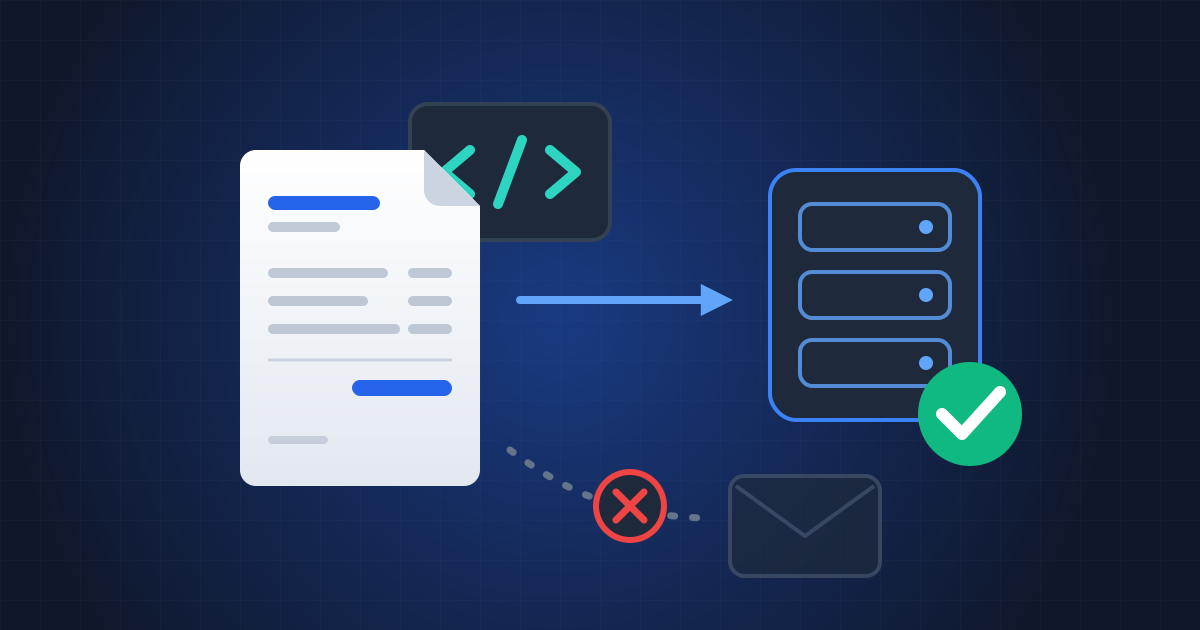
For twenty years, in most small businesses, an "electronic invoice" meant a PDF attached to an e-mail. In France, since 1 September 2026, that's no longer the case. The French e-invoicing reform has come into force, and France's tax authority, the DGFiP, puts it bluntly: a scanned paper invoice, an ordinary PDF or a document sent by e-mail will no longer comply with the rules (impots.gouv.fr).
Does that mean binning the PDF invoices that arrived this month? No. The timetable is phased, and the authorities have allowed for a bedding-in period. Here's what applies to whom, and from when — and, if your business isn't based in France, whether any of it concerns you.
Who's affected, and since when?
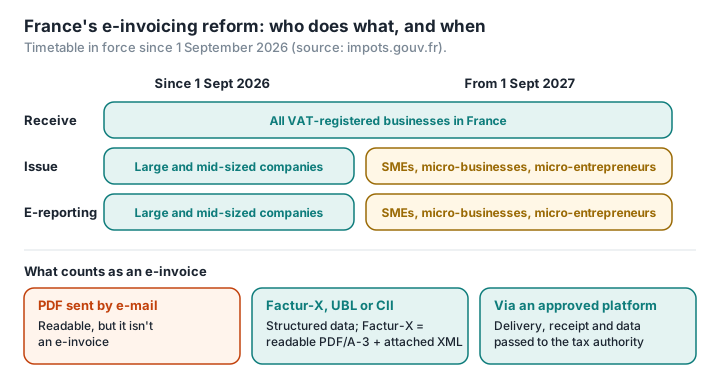
The reform covers transactions between businesses that are subject to VAT and established in France — micro-entrepreneurs (France's simplified self-employed status) included, even those exempt from charging VAT. It's being rolled out in two stages (LegalPlace, economie.gouv.fr, impots.gouv.fr):
- since 1 September 2026, every business has had to be able to receive e-invoices; large companies and mid-sized companies (ETIs in French terms, with 250 to 4,999 employees) must also issue them;
- from 1 September 2027, SMEs (PMEs), very small businesses (TPEs) and micro-entrepreneurs will have to issue them too.
The timetable hasn't moved. On 1 September, David Amiel, the minister responsible for public accounts, called it "a kick-off, not a cliff-edge deadline" (press release of 1 September 2026). By that date, more than four million businesses had registered an address for receiving invoices, and 66% of the businesses concerned had chosen their platform. The state expects the reform to save some €4 billion a year and to tighten control of VAT, where the gap between what's due and what's collected is estimated at €10 billion to €20 billion (DGFiP report, 2020).
If you're not based in France. What counts is where the business is established, not where its owner comes from: a French subsidiary of a British group, or a British freelancer registered as a micro-entrepreneur in France, is covered like any other French business. Foreign companies with no permanent establishment in France for VAT purposes, on the other hand, aren't concerned by the e-invoicing side of the reform — receiving and issuing e-invoices (impots.gouv.fr). When one of them sells to a business registered for VAT in France, it doesn't owe French VAT: the customer accounts for it (reverse charge) and reports the transaction. If it does owe French VAT on sales deemed to take place in France, it has to report them to the tax authority (e-reporting) through an approved platform, from 2026 or 2027 depending on its size.
French businesses, for their part, don't e-invoice their transactions with customers and suppliers abroad: international transactions come under e-reporting, as the glossary below explains.
What about where you are? In the UK, e-invoicing is still voluntary; at the Budget in November 2025, the government announced that it will become mandatory for all VAT invoices from 2029, with a roadmap due at Budget 2026 (GOV.UK). In the European Union, the VAT in the Digital Age package (ViDA), adopted in March 2025, has let member states make e-invoicing compulsory for domestic transactions, under certain conditions, since April 2025; from 1 July 2030, it will be mandatory for cross-border business-to-business transactions within the EU (European Commission, European Commission). These are pointers, not a guide: for the rules that apply to your business, check with HMRC or your own country's tax authority.
Why isn't a PDF an electronic invoice any more?
Because an e-invoice, as the reform defines it, isn't a document you read: it's a set of structured data that software can process with no human involvement — number, date, the supplier's and the customer's SIREN (the identification number of a French business), amounts, VAT. The reform has also added new mandatory details, including the customer's SIREN (LegalPlace). LegalPlace's guide puts it unambiguously: "A PDF is not an electronic invoice within the meaning of the reform, even if it is perfectly legible and sent by e-mail" (LegalPlace). In other words, an invoice can be "entirely paperless without being an electronic invoice in the legal sense" (LegalPlace). An ordinary PDF is a picture of an invoice; an accountant can read it, but a program can't reliably interpret it.
Three formats are accepted (LegalPlace, DGFiP factsheet):
- UBL and CII, two pure data formats with no visual rendering;
- Factur-X, a Franco-German "hybrid" format: a PDF that a person can read, carrying as an attachment an XML file that a machine can read. Technically, it's a PDF/A-3 — a variant of PDF designed for archiving, which allows attached files (FNFE-MPE).
The format isn't enough. The invoice also has to go through an approved platform: the issuer uploads it to its platform, which passes it on to the recipient's platform and sends certain data to the tax authority. A perfect Factur-X sent by e-mail is still outside the system.
What is an approved platform, and are there free ones?
Approved platforms (plateformes agréées, or PAs, formerly known as PDPs) are private operators registered by the tax authority for three years. The DGFiP describes the arrangement as "a network of private platforms, but approved and supervised by the state" (press release of 16 January 2026). The first list had 101; it now has more than 140, and the official list is updated regularly.
There's no free public option (LegalPlace). The state had planned one; it dropped the idea in October 2024, and the public invoicing portal (PPF) is now limited to a directory of recipients and the collection of data (KPMG Avocats). Several platforms do, however, offer free plans, particularly for micro-entrepreneurs; a community-maintained list is kept on data.gouv.fr, the French government's open-data portal.
I'm still receiving PDF invoices: what should I do with them?
It's been the most common question this September, and the practical guide the tax authority published in July answers it clearly (DGFiP guide).
A PDF invoice from an SME is normal until 1 September 2027. Until it has voluntarily joined the system, an SME, a very small business or a micro-entrepreneur "may carry on in its usual way", and its customer can't insist on anything else.
A PDF invoice from a large company or an ETI mustn't be rejected on that ground alone: "an invoice received by e-mail, as a PDF or on paper must not be rejected solely because it was not sent through the channel" the reform expects, as long as the transaction is real and the required details are on it. Asking the supplier to put it right is possible, but "is not mandatory and is not a condition of validity". For the issuer, on the other hand, it's only a fallback channel if something goes wrong.
Watch out for duplicates. If the same invoice arrives through the platform and by e-mail, the guide recommends designating one as the "reference invoice" and treating the other as a copy.
Rejecting an invoice is only possible for regulatory non-compliance or an addressing error, not for a commercial dispute. Hence the point of checking that your own SIREN, your SIRET (the number identifying each of a business's premises) and your receiving address are correctly listed in the directory: addressing errors are among the problems most often reported since the start of September (Moneyvox, Compta-online).
What are the penalties, and from when?
The 2026 Finance Act (France's annual budget law) raised the fines. The analyses of several software publishers and lawyers agree (LegalPlace, Dougs, Actu-Juridique): €50 per invoice not issued electronically, capped at €15,000 a year; for a business that hasn't signed up to a platform for receiving invoices, a formal notice, then a fine if the situation isn't put right within three months. A first offence corrected spontaneously or within thirty days isn't penalised.
On when penalties begin, there are two messages. The minister has said that "no penalties will be applied in 2026". The tax authority's guide is more nuanced: no penalties for businesses "on a serious path to compliance", but inaction or a persistent refusal can still be penalised. The safe course is to go by the second reading — and to keep proof of the steps you've taken: your choice of platform, exchanges with your software provider, problems encountered.
Mistakes to avoid with a Factur-X invoice
A Factur-X invoice looks like any other PDF. That's what makes it fragile. Its XML is an attached file that doesn't show on screen, and its PDF/A compliance depends on strict rules. Yet many PDF tools, online or not, don't keep attachments or archival compliance when they transform a document.
Leave it as it is. Compressing a Factur-X to make it lighter, merging it with a purchase order, adding a stamp or a watermark can strip out the XML or break PDF/A compliance. The document will still be readable; it won't be an e-invoice any more.
Keep the original as received, and work on a copy if you need to annotate it, put it together with other documents or send someone a lighter version. The retention rules (ten years under the French Commercial Code, six years for tax documents) apply to the original invoice (LegalPlace).
Don't hand it to just any website. An invoice carries your bank details, your customer's details and your prices. For routine jobs on a copy — putting expense receipts together, extracting a page, shrinking a scan to send to your accountant — a tool that works locally avoids scattering that information. That's what PDFKami does: files are processed in your browser and aren't sent anywhere. PDFKami doesn't create e-invoices, though, and doesn't replace an approved platform: to issue them, you need invoicing software connected to a PA — LegalPlace has a comparison (in French).
Glossary
Electronic invoice (e-invoice): an invoice issued, sent and received as structured data, through an approved platform. A PDF sent by e-mail isn't one.
UBL, CII: invoice data formats (XML), with no visual rendering.
Factur-X: a Franco-German hybrid format — a readable PDF/A-3 containing structured XML. German equivalent: ZUGFeRD.
PDF/A-3: a standardised variant of PDF designed for archiving, which allows attached files.
Approved platform (PA): an operator registered by the French authorities to issue, send and receive e-invoices and pass their data on to the tax authority.
PPF (portail public de facturation): the state's public invoicing portal, cut back to a directory of recipients and the collection of data.
E-reporting: sending the tax authority data on transactions that don't come under e-invoicing (sales to private individuals, international transactions).
ETI: entreprise de taille intermédiaire, a mid-sized company with between 250 and 4,999 employees.