
Since 1 January 2023, every company formality in France, from registering a business to changing its address or closing it, has gone through a single website: the guichet unique ("one-stop shop"), run by INPI, the French national institute of industrial property. This article is for anyone setting up or taking over a company in France, or registering as self-employed there, including from abroad. The volume is considerable: according to the French government, 5.2 million formalities had been filed there by mid-2025, including 1.3 million company creations in 2024 alone, at a rate of nearly 100,000 formalities a week (Assemblée nationale). Behind every filing there's a step people underestimate: getting the documents together in the right format. That's often where a filing gets bogged down.
What are the file rules?
They come down to three sentences, published on the official site (formalites.entreprises.gouv.fr):
- "Only the PDF format is accepted."
- "The maximum size for each file is 10 MB."
- "Until all the documents have been provided, the guichet unique blocks the submission of the declaration."
So a photo of your identity card taken on your phone won't be accepted as it is: it has to be converted to PDF. A high-resolution scan of the statuts (the company's articles of association) can go over 10 MB. And the documents required depend on what you enter: the guichet unique lists them as you work through the form, which is why it pays to have them ready before you start. LegalPlace, a French legal-services platform, sums it up: a "document in the wrong format can seriously delay the processing of your file" (LegalPlace).
Which documents do you need?
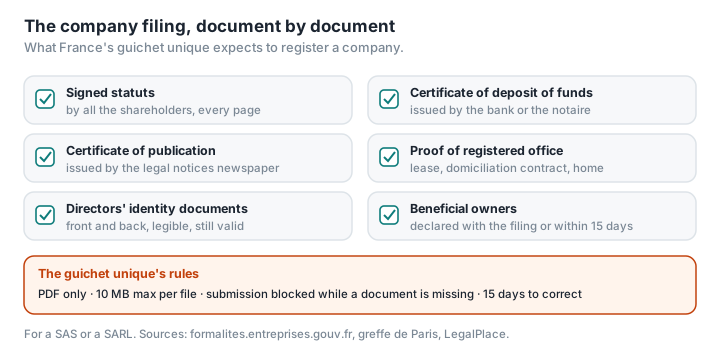
For a SAS or a SASU (the société par actions simplifiée, France's most popular company form, with several shareholders or just one), the Paris greffe, the commercial court registry that keeps the register of companies, lists (greffe de Paris):
- a copy of the statuts "dated and signed in the original by all the shareholders";
- the certificate from the depositary of the funds, with the list of subscribers;
- the deed appointing the président (the company's legal representative) if they aren't named in the statuts;
- the report of the commissaire aux apports (an independent valuer) where assets other than cash are contributed;
- "a document proving lawful occupation of the premises of the registered office": a lease, a domiciliation contract (with a company that provides a registered address), an electricity or phone bill (we come back to this in Registered office: what proof do you need?);
- "a certificate of publication of the notice of the company's creation in a journal d'annonces légales", a newspaper authorised to carry legal notices;
- a copy of each director's identity document;
- the declaration of beneficial owners, which the greffe charges for together with registration when it's filed at the same time.
LegalPlace goes through these documents in its guides to setting up a SAS (LegalPlace) and a SARL (société à responsabilité limitée, the classic private limited company), whose filing brings together a comparable list (LegalPlace). The certificate of publication is essential: "Without this certificate, the file is incomplete" (LegalPlace), as is the certificate of deposit of funds: "This document must be attached to the registration file" (LegalPlace). As for the statuts, what their PDF file says about you is the subject of Articles of association and minutes: what your PDF reveals.
The declaration of no criminal convictions and of parentage gets conflicting instructions: the Paris greffe lists it among the documents for foreign directors, while several guides ask for it from every director, including for a SARL (LegalPlace). If in doubt, it's best to provide it.
For a micro-entreprise (France's simplified sole-trader scheme), the list is shorter: an identity document front and back, proof of address less than three months old, a sworn declaration of no criminal convictions and a certificate of parentage, plus diplomas or authorisations if the activity is regulated (LegalPlace). If you're living in someone else's home, you may be asked for an attestation d'hébergement (a letter from your host confirming you live with them) less than three months old, signed by your host, together with their identity document (Swim).
The declaration of beneficial owners lists the people who hold, directly or indirectly, more than 25% of the capital or voting rights, or who exercise control by any other means; failing that, the legal representatives (formalites.entreprises.gouv.fr). It's filed at registration or no later than fifteen days after the receipt for the filing (formalites.entreprises.gouv.fr, LegalPlace).
Why do filings get rejected?
The authorities don't publish a rejection rate: according to the government, rates "vary between validators" (Assemblée nationale). Practitioners always cite the same causes (LegalPlace, LegalVision, Swim):
- an illegible document: a blurred or cropped identity document, corners cut off, a crooked scan;
- a missing or incomplete document: statuts without all the signatures, a front without the back;
- an inconsistency between the form and the documents: a date, address, name or amount of capital that differs from one document to another;
- a missing signature on the formality.
When the filing is incomplete, the formality goes "en attente de régularisation" (awaiting correction). This status "suspends the time limit" the competent body has to validate the filing, and you have 15 days to correct your declaration; if you do nothing, "the formality will be automatically rejected". Any correction "in all cases requires a new signature of all the information declared" (formalites.entreprises.gouv.fr). A refusal costs money too: according to a firm that handles company formalities, a reading of the rules applied by the Versailles greffe since spring 2026, which the Conseil national des greffiers (the national body of court registrars) has invited all greffes to follow, means the registry fees are kept if the filing is finally refused; you then have to pay them again to file once more (LegalVision).
How should you prepare your files?
One document, one PDF, legible. Photograph or scan each document flat, in even light, with all four corners visible. For an identity document, put the front and back in the same file.
Convert photos to PDF with JPG to PDF: two photos become a two-page PDF, without being uploaded.
Put multi-page documents together with Merge PDF, which also accepts images, and put them back in order with Organise PDF: statuts scanned page by page must form a single, complete file, initials and signatures included.
Get under 10 MB with Compress PDF, checking by eye that the text is still legible: compressing too hard can turn a valid document into an illegible one. We explain the settings in Compress a PDF to send by email.
Check for inconsistencies before you submit: the same registered office address on the form, the statuts and the proof; the same amount of capital on the statuts and the certificate of deposit; the same first names and surnames everywhere.
Why do all this locally? Because these few files bring together your identity document, your address, your statuts and your capital. Uploading them to an online converter before sending them to INPI means handing them to one more intermediary; we go into what happens to those files in Where do your PDF files go online?. The tools on PDFKami run in your browser: your files never leave your computer.
How long does it take, and how much does it cost?
The guichet unique gives no standard timeframe: "The processing time depends on the nature of your formality" (formalites.entreprises.gouv.fr), and you follow progress from your personal account. As for fees, since 1 March 2026 the greffe's fees for registering a commercial company have been €22.14 excluding VAT, and those for the declaration of beneficial owners €16.11 excluding VAT (formalites.entreprises.gouv.fr). With VAT and the cost of filing the company's documents, the Paris greffe asks for €53.16 in total for a SAS (greffe de Paris). Micro-entrepreneurs are exempt from some fees (formalites.entreprises.gouv.fr). On top of that comes the legal notice, whose flat rate for 2026 depends on the company form: €124 excluding VAT for an EURL (a single-member SARL), €142 for a SASU, €148 for a SARL and €199 for a SAS in mainland France (LegalPlace).
What about where you are? In the UK, you register a limited company with Companies House, online through GOV.UK: it costs £100, paid by debit or credit card, and the company is "usually registered within 24 hours"; registering by post (form IN01) costs £124 and takes 8 to 10 days (GOV.UK). Since 18 November 2025, identity verification has been a legal requirement for directors and people with significant control: each verifies once, for example with GOV.UK One Login, and receives a personal code, which a director provides when the company is incorporated (GOV.UK).
Glossary
Guichet unique: the official website, run by INPI, through which every company formality in France has gone since 2023.
RNE: the registre national des entreprises, France's national register that centralises information on every business.
Certificate of publication: the document from the journal d'annonces légales proving that the notice of creation has been published.
Beneficial owner: a person who holds, directly or indirectly, more than 25% of the capital or voting rights, or who controls the company by other means.
Régularisation: a request to correct an incomplete filing, with 15 days to respond.
Prepare your documents without sending them to a third party: PDFKami, in your browser.