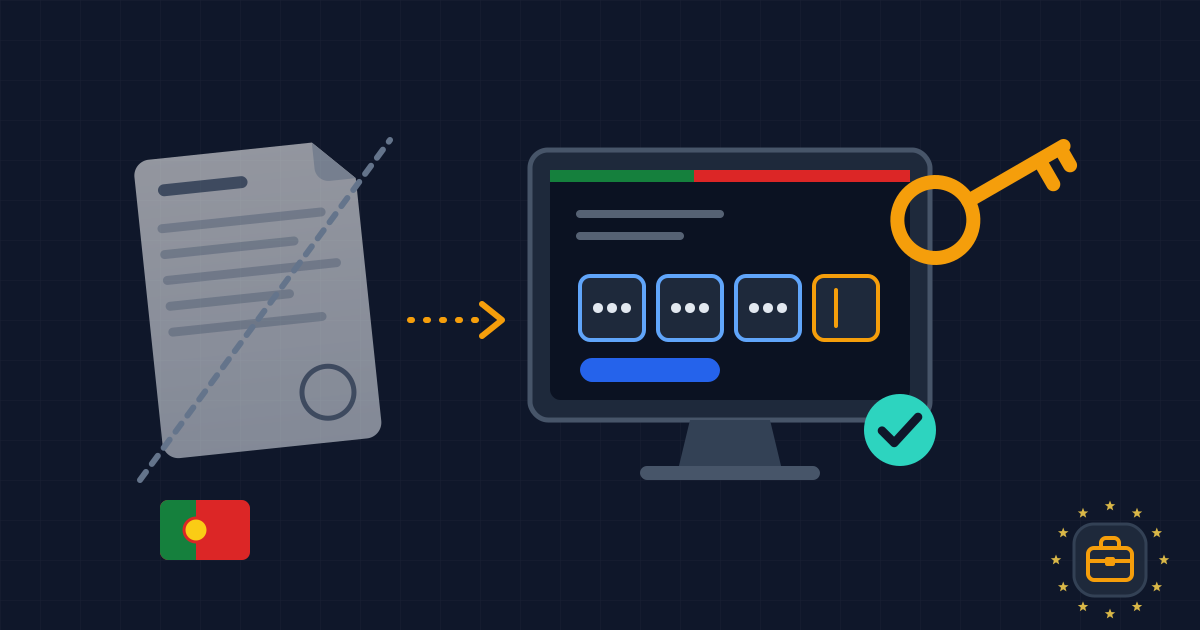
In France, proving that a company exists means sending a Kbis, the official extract from the trade and companies register: a dated document that the recipient usually wants to be less than three months old, and whose authenticity they then have to check. In Portugal, since December 2006, you can send nothing at all. You pass on a code, and the recipient reads the official register for themselves. The idea sounds simple; it removes much of what makes the Kbis fragile.
How do you set up a company in Portugal?
The best-known route is called "Empresa na Hora", the company "on the hour". Introduced in 2005, it lets you form a trading company in a single visit to the counter: the registry must begin and complete the procedure "no mesmo dia, em atendimento presencial único", on the same day, in a single in-person appointment, as the decree-law puts it (Decreto-Lei n.º 111/2005, art. 5). "One hour" is a slogan; the law says "the same day".
The conditions, according to the registry's official website (registo.justica.gov.pt):
- a standard legal form: single-member private limited company, private limited company by quotas (the equivalent of a French SARL, or a UK Ltd) or public limited company;
- a company name chosen from a pre-approved list, or already cleared;
- articles of association on a pre-approved template;
- all the members present at the counter, wherever the future registered office will be;
- an identity document and the tax number (NIF) of each member;
- 360 euros for a standard application.
The members leave with the articles of association, the company's Social Security number and two codes: one for the company card, the other for the certidão permanente. What remains is to pay the share capital into the company's account within 5 working days, if it was not done beforehand, and to declare the beneficial owners within 30 days; if no accountant was appointed at incorporation, a start-of-activity declaration must also be filed with the tax authority within 15 days. There is an online version too, with electronic authentication (registo.justica.gov.pt).
The scheme has been a success: 115,000 companies had been formed through it in six years, according to a 2011 review (HR Portugal). In 2025 the country set a record for new businesses, with 53,782 companies and other organisations formed (Informa D&B).
What is the certidão permanente?
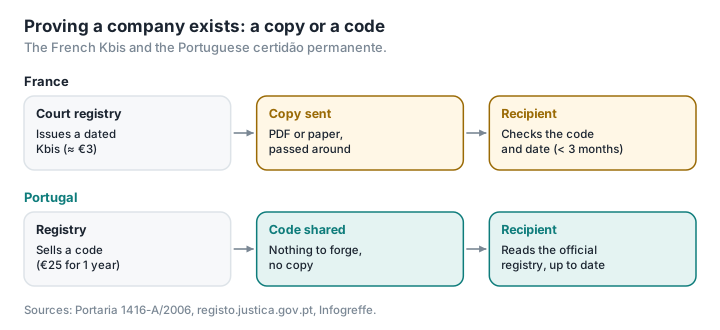
It is Portugal's equivalent of the Kbis, but in the form of access rather than a document. Created by a ministerial order of December 2006, it makes available, "em suporte electrónico e permanentemente actualizado", in electronic form and constantly updated, a reproduction of the entries currently in force on the register. The applicant receives a code, and the order sets out the principle: handing that code to any public or private body is equivalent to handing it a certificate from the register (Portaria n.º 1416-A/2006).
In practice, the company pays for one to four years and receives an alphanumeric code by email. It passes the code to its bank, a client, a notary. The recipient enters it on the official portal, without creating an account, and sees the state of the register at the moment they look, not a snapshot frozen on the date of issue (CRN Contabilidade).
The official fees depend on the duration and the content (registo.justica.gov.pt):
| Content | 1 year | 2 years | 3 years | 4 years |
|---|---|---|---|---|
| Register entries | €25 | €40 | €60 | €70 |
| Entries and filed documents | €55 | €88 | €132 | €154 |
| Articles of association only | €20 | €35 | €45 | €50 |
The official page puts it plainly: presenting the access code "replaces the paper certificate".
What difference does it make compared with the Kbis?
Three things, all of them to do with forgery and with copies going round.
There is no document to forge. A fake Kbis is an altered PDF or paper copy; the recipient has to check it, using the verification code or the QR code from Infogreffe, the official portal of France's commercial court registries (Infogreffe). With a Portuguese code, the recipient reads the official source directly. A made-up code leads nowhere. We found no Portuguese statistics on forged certificates; the argument remains reasoning, not measurement.
The information is always current. A Kbis is dated, which is why it is so often asked for again: most organisations want an extract less than three months old, by custom rather than because of any legal period of validity (LegalPlace). A Portuguese code shows that day's register for as long as it is valid, up to four years.
No copies go round. A Kbis sent to a supplier stays in their inbox; it can be reused, forwarded, imitated. The code only gives read access to the register, which is public anyway.
France is not so far from this model: the extract from the national business register (RNE, registre national des entreprises) is free and anyone can download it with the company's SIREN number, and since 1 November 2021, 55 administrative procedures need only the SIREN, with the administration fetching the information itself (Direction générale des entreprises; see our article on the Kbis). The principle is the same: check the source rather than receive a copy.
Does the system have limits?
Yes, at least two.
In court, the code is not always enough. On 14 January 2025, the Coimbra Court of Appeal ruled that "a simples entrega do código de acesso", merely handing over the access code to a permanent certificate, is not the same as producing the document in court proceedings (Tribunal da Relação de Coimbra). What works in business dealings does not necessarily work before a judge.
Middlemen get involved. In February 2025, a private website that came top of the search results charged 49.08 euros for a certificate that costs 25 on the official portal; the customer believed she was "no sitio certo, plataforma oficial", on the right site, the official platform (Portal da Queixa). France has exactly the same problem with fake Kbis ordering sites, which Infogreffe lists in a directory (Infogreffe), and with the misleading letters that follow company registration (see scams after registration).
What about beneficial owners?
Portugal is following the same path as France. Until 2025, any authenticated citizen could consult the register of beneficial owners (RCBE) simply by stating a reason (HR Portugal). Since Decree-Law n.º 115/2025 of 27 October 2025, which transposes the new EU anti-money-laundering directive, the information is available only to those who show "um interesse legítimo", a legitimate interest, and every search is logged (Cuatrecasas). This follows the November 2022 ruling of the Court of Justice of the European Union, which struck down general public access to these registers.
And digital signatures?
They are the other pillar of the Portuguese system. The Chave Móvel Digital, the state's mobile digital key, "é gratuita", is free, and can be activated by Portuguese nationals and foreigners alike (gov.pt). It lets you sign documents from your phone, with, according to the government, the same validity as a handwritten signature (gov.pt). It has more than 5 million active users, and the number of signatures rose from 38,361 in 2018 to more than 19.4 million in 2025, according to the public agency that runs it (Renascença).
The comparison with France is telling: in France, signing articles of association electronically goes through a private signature provider; and when the articles are signed by hand and scanned, the image of the signature can be viewed along with the filed document (see the episode on articles and minutes). In Portugal too, company filings are public: since 2006 they have been published on a Ministry of Justice website, publicacoes.mj.pt, which replaced publication in the Diário da República, the official gazette.
What can France take from it?
The Portuguese idea fits in a sentence: share access rather than a copy. It does not exist in this form for the Kbis, but it can guide a few habits:
- when a partner asks for a Kbis, offer the SIREN number instead, which lets them download the up-to-date RNE extract for free;
- when you really do have to send a document, send only that one, and watermark it with the recipient's name and the purpose: Watermark PDF does it in the browser, without uploading the file;
- when you receive a document, check it at the source rather than trusting how it looks.
PDFKami issues neither Kbis extracts nor certificates, and is no substitute for checking the register. Its tools are for preparing, slimming down and marking the copies you could not avoid sending.
Glossary
Empresa na Hora: Portuguese procedure for forming a company in a single visit to the counter, in force since 2005.
Certidão permanente: certificate from the Portuguese commercial register, accessible online with a code for one to four years.
NIF: Portuguese tax identification number, required to set up a company.
RCBE: central register of beneficial owners, Portugal's equivalent of the French RBE (registre des bénéficiaires effectifs) and of the UK's PSC register.
Chave Móvel Digital: free digital authentication and signature service provided by the Portuguese state.
Watermark the copy you can't avoid sending: PDFKami, in your browser.