In 2016, a British businessman, Kevin Brewer, incorporated a company naming as its directors, without their knowledge, the minister responsible for Companies House, Baroness Neville-Rolfe, and an MP, James Cleverly. He had already done the same in 2013 in the name of Vince Cable, then Business Secretary. His point was simple: anyone could set up a company in anyone's name, without the slightest identity check. Prosecuted for filing false information, he pleaded guilty in 2018 and paid more than £12,000 in fines and costs (GOV.UK). His demonstration, for its part, took seven years to produce a law.
Seen from France, where company formation has long gone through a court registry, the story is worth telling: it shows what radical openness gives, and what it costs.
Why call it Europe's "most open" register?
Because everything is free and online. Since June 2015, searching the Companies House register has cost nothing. Data access grew from around 1.3 billion in 2015-16 to more than 16 billion in 2023-24, and a study cited by the government puts the value of that data at between £1 billion and £3 billion a year to its users (Companies House). The register held 5,516,377 companies at the end of June 2026 (GOV.UK).
Filed documents can be downloaded as they are, as images (GOV.UK). They contain what company documents contain: signatures, occupations and, in older filings, home addresses and full dates of birth. The proof is the procedure that now lets you have them removed (see below).
France made a similar but less radical choice: the extract from the national business register (RNE, registre national des entreprises) is free, and filed articles of association can be viewed with a free account on data.inpi.fr, the site of the French intellectual property office, which runs the register (see the episode on articles and minutes).
What did that openness make possible?
For years, Companies House recorded whatever it was told, without checking. The documented abuses are many:
- companies in the names of real people: in 2022, nearly 80 companies were created in three months on the same pattern, naming as owners dozens of Britons and Americans whose identities were used without their consent. "They won't lend you books from the library without being certain who you are", as one specialist put it (Byline Times);
- civil servants impersonated, from the Ministry of Justice and HMRC, whose identities were used to set up companies (openDemocracy);
- "cloned" companies: some 750 companies with names imitating real businesses, including restaurants run by well-known chefs, used to obtain overdrafts and place orders that were never paid (Identity Week);
- hijacked homes: in 2024, on one street in Billingshurst, a village in West Sussex, 70 companies were registered in a single week at 38 houses, without the occupants knowing. Registering an office did not require "any proof of residency or connection to the property" (LBC).
What did the 2023 reform change?
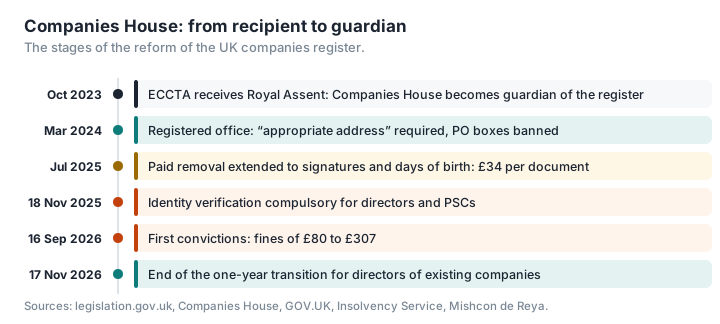
The Economic Crime and Corporate Transparency Act, which received Royal Assent in October 2023, turned Companies House from a passive recipient of filings into the guardian of the register (legislation.gov.uk). Its measures are arriving in stages.
Since March 2024, the registered office must be an "appropriate address", one where post actually reaches someone acting for the company; PO boxes are banned (legislation.gov.uk, Companies House). Companies House can now query, reject or remove information, and replace a fraudulent registered office address with its own default address (Companies House). France has long required something comparable: every company must prove it is entitled to occupy its registered office, whether at the director's home, in rented premises or with a licensed domiciliation provider (see registered office and domiciliation in France).
The removal of personal data has been widened. Anyone can ask for their home address to be removed from documents already filed, for instance where it served as a service address or registered office; since 21 July 2025, you can also have your signature, the day of your date of birth (on documents filed before October 2015) or your occupation removed. But privacy comes at a price: "It costs £34 to remove your personal details from each document", with a paper form, SR01, posted to Cardiff (GOV.UK). In France, a director's home address can be masked since the decree of 22 August 2025, for a few euros per document, and free of charge on the Kbis (the French register extract) when requested alongside a filing (Infogreffe, see the episode on articles and minutes).
Since 18 November 2025, identity verification for directors and persons with significant control has been a legal requirement. For existing companies, that date opened a twelve-month transition: "This date is not a deadline", the government points out (GOV.UK). Existing directors must confirm their verification with the company's next confirmation statement (GOV.UK); the transition ends on 17 November 2026 (Mishcon de Reya).
How does identity verification work?
There are four routes (GOV.UK): the GOV.UK One Login app or website, with photo ID; bank details and a National Insurance number; in person at a Post Office; or through an authorised professional such as an accountant or solicitor. Through GOV.UK One Login, it is free (GOV.UK). With no national identity card in the UK, the document used is a passport or driving licence (see the next episode).
With the app, you record a short video of your face, which is compared with the photo on the document. According to the privacy notice, the video is not kept, images and biometric data are deleted from the providers' systems after 30 days, and several providers are involved: a facial recognition company and its subcontractors, and a credit reference agency for anti-fraud checks (GOV.UK). You then receive a personal code, which you supply for each of your appointments.
The result, as at 31 March 2026: 3.81 million personal codes issued, 151,000 registered office addresses removed from the register for misuse, and 77,900 incorporation documents redacted because personal data had been used without consent (official report). By the end of June 2026, however, only around 55% of directors and 42% of persons with significant control had done it, according to management information published by Companies House on 30 July 2026 (Law Debenture, Companies House).
What happens if you don't?
The first convictions came on 16 September 2026: three directors, fines of £80 to £307, plus costs. One of them, although verified, was convicted for failing to stop his unverified co-director from acting. "There is no option to opt out", commented a lawyer at the Insolvency Service, which brings the prosecutions (GOV.UK). The sums are modest; the message is not.
Did the scams follow?
Of course. Companies House keeps a page on scams that impersonate it: calls from a "registration service" that does not exist, fake penalties payable by card, fake identity verification emails, letters with QR codes, fake registers demanding fees: "This is not a real fee and Companies House is not connected to any of these organisations" (GOV.UK). The rule of thumb is simple: genuine emails come from an address ending in ".gov.uk". The reform has even created a new bait, the fake identity verification request.
It is exactly the same mechanism as the misleading letters French companies receive after registration (see scams after company registration in France).
What can a French entrepreneur take from this?
A public register is public to everyone. Whatever you file there, signature and address included, can be read, copied and reused. The UK has learnt this on a large scale, and the remedy there is paid for, document by document. In France, the best protection is still to file clean documents from the start: articles of association with no comments or metadata, and a home address masked where possible (see the episode on articles and minutes). The same advice holds for a director filing at Companies House.
Identity verification moves the risk; it does not remove it. You now have to hand your ID and your face to providers, and fake messages already imitate these requests. Before sending an identity document, check who is asking, and mark the copy with the recipient's name using Watermark PDF, in your browser.
PDFKami does not deal with Companies House or any register on your behalf; its tools are for preparing, cleaning and marking documents before you file or send them.
Glossary
Companies House: the UK public body that keeps the register of companies. Its French counterparts are the court registries (greffes) and the RNE.
ECCTA (Economic Crime and Corporate Transparency Act 2023): the UK law that strengthened the powers of Companies House and introduced identity verification.
PSC (person with significant control): a person who controls a UK company, the equivalent of the beneficial owner (bénéficiaire effectif) in France.
Registered office: the official address of a UK company, which must now be an "appropriate address"; in France, the siège social.
Confirmation statement: the annual filing in which a UK company confirms its details on the register.
GOV.UK One Login: the UK government's online sign-in and identity service.
ACSP (Authorised Corporate Service Provider): a professional authorised to verify directors' identities on behalf of Companies House.
Mark a copy of an ID document with its recipient's name, without uploading it: PDFKami, in your browser.