France is only now discovering mandatory e-invoicing: since 1 September 2026, every business there must be able to receive electronic invoices, and small and medium-sized businesses will have to issue them from September 2027 (see Your first invoice in France). Italy took the plunge on 1 January 2019. Seven years on, it has something France does not yet have: hindsight. What has worked, what still sticks, and one lesson that matters to anyone who produces their invoices as PDFs.
How does the Italian system work?
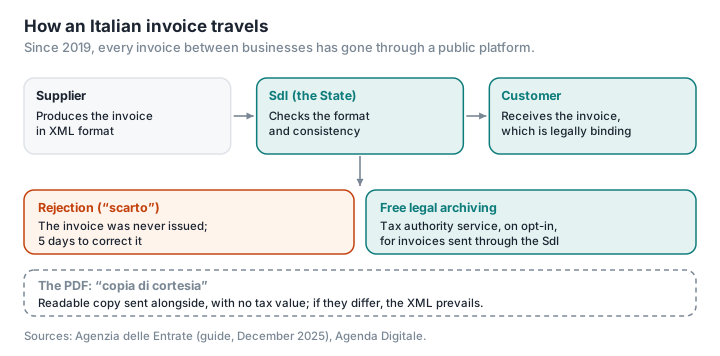
Every invoice between businesses established in Italy, and those they send to private customers, goes through a single public platform, the Sistema di Interscambio (SdI), run by the tax authority. According to the Agenzia delle Entrate's guide, the invoice, in XML format, "deve essere trasmessa elettronicamente all'indirizzo telematico dove il cliente vuole che venga consegnata la fattura, tramite il c.d. Sistema di Interscambio": it must be sent through the SdI to the electronic address chosen by the customer. An invoice drawn up in any other form, or sent through any other channel, is deemed not to have been issued, and the customer cannot deduct the VAT. When the supplier hands over a paper or digital copy, it must point out that "la fattura originale è quella elettronica": the original is the electronic invoice (Agenzia delle Entrate, December 2025 guide).
The roll-out came in stages: invoices to public bodies in 2014–2015, all invoices between businesses in 2019, then sole traders on the flat-rate scheme, known as forfettari: in July 2022 those with turnover above €25,000, and all of them since 1 January 2024 (Decree-Law No. 36/2022, Art. 18, Gazzetta Ufficiale). In 2025, the tax authority received and processed "2,4 miliardi di e-fatture", 2.4 billion electronic invoices (Agenzia delle Entrate, press release of 25 March 2026).
The scheme began as a derogation from EU VAT law, authorised by the Council of the EU and extended to 31 December 2027 (EUR-Lex). The EU reform known as ViDA, adopted on 11 March 2025, now allows member states to require e-invoicing for domestic transactions; it will make e-invoicing mandatory for trade between businesses in different EU countries from 1 July 2030, and national real-time reporting systems will have to align with the EU model by 2035 (European Commission).
What happens to the PDF?
It becomes nothing more than a view. The readable document that many businesses still attach to their emails is called a copia di cortesia, a courtesy copy: "Tale documento non è valido a fini fiscali né per l'emittente né per il ricevente", it has no tax value for either the issuer or the recipient; if the two differ, the file sent to the SdI prevails. It customarily carries the words "Copia di cortesia non valida ai fini fiscali" (Agenda Digitale).
That is exactly what lies ahead for French businesses. An electronic invoice under the French reform is a structured file, in Factur-X, UBL or CII format, sent through an approved platform; from September 2027, an ordinary PDF sent by email will no longer be enough for small and medium-sized businesses. Factur-X has one particular feature: it is a readable PDF that also carries the structured data, in an attached XML file. So the PDF does not disappear in France; its status changes (see E-invoicing in France: is your PDF invoice still valid?).
Can an invoice be rejected?
Yes, with serious consequences. The SdI checks every invoice: that the mandatory details are present, that the supplier's VAT number and the customer's VAT number or tax code exist, that the taxable amount, rate and VAT amount are consistent, and that it is not a duplicate. If it is rejected, "una ricevuta di scarto determina che la fattura non è mai stata emessa": a rejection notice means the invoice was never issued. Checking and delivery take anything from a few minutes to five days at most, depending on the load on the system (Agenzia delle Entrate, December 2025 guide). The supplier then has five days from the rejection notice to resend the corrected invoice with the same number and date; it is then treated as issued on time (Agenzia delle Entrate, ruling No. 103/2024). We have not found any recent official statistics on rejection rates.
How much does it cost small businesses?
Nothing, if they so wish. The Italian tax authority provides three free tools for drawing up invoices (an online service, desktop software and a mobile app), as well as "un servizio di conservazione a norma", legally compliant archiving, for all electronic invoices issued and received; businesses simply opt in from their online account (Agenzia delle Entrate, December 2025 guide). The chambers of commerce also offer small businesses a free service for issuing, receiving and archiving invoices (InfoCamere).
In France, there is no free public solution for exchanging invoices: businesses must use one of the approved platforms, some of which offer limited free plans (LegalPlace). Archiving remains the business's own responsibility (see How long to keep business records in France).
Has VAT fraud gone down?
Yes, at first, but the answer calls for caution. According to the Italian Ministry of Economy and Finance's annual report published in 2023, the share of VAT not paid fell from 27.3% of theoretical VAT liability in 2017 to 19.9% in 2019. The ministry attributes the sharp improvement in 2018–2019 to two measures: the extension of split payment, under which public-sector buyers, and later certain state-controlled or listed companies, pay the VAT straight to the Treasury, and "la fatturazione elettronica, introdotta nel 2018 per alcune categorie di soggetti e generalizzata nel 2019". It puts their combined effect on undeclared VAT at around 2 percentage points and €2.8 billion (MEF, 2023 report).
Three caveats apply:
- the figures are revised from one edition to the next: the 2026 edition of the same report now puts the 2019 gap at 22.6%, not 19.9% (MEF, 2025 report, MEF, 2026 report);
- the decline did not continue: the VAT gap rose from €30.7 billion in 2022 to €34.4 billion in 2023, or from 19.4% to 20.3% of VAT due, according to the 2026 edition (MEF, 2026 report);
- methods differ: the European Commission estimates Italy's gap at 15% in 2023, against an EU average of 9.5% (European Commission).
So it is fair to say that e-invoicing helped reduce fraud; it is not possible to say by how much on its own.
What fraud remains?
Fake invoices between shell companies. The SdI checks the form of an invoice, not whether the sale really happened. Schemes built on cartiere, shell companies that issue fictitious invoices, carry on; in July 2025, the Guardia di Finanza (Italy's financial police) in Udine uncovered some €50 million in fictitious invoices (ItaliaOggi). The system does, however, help to detect them: in the first two months of 2019, analysis of electronic invoices identified €3.2 billion in fictitious purchases and blocked €688 million in false VAT credits; the 37 companies involved operated mainly in the wholesale trade in petroleum products, according to the Agenzia delle Entrate as cited by the Lucca chamber of commerce (Camera di commercio di Lucca, CorCom).
Fake-invoice phishing. This is the most visible side effect. Italian businesses receive invoices electronically every day, and scammers imitate those messages. In September 2025, a fake file-transfer link offered a "FatturaAgenziaEntrate.pdf" download designed to steal email credentials (InvestireOggi); in June 2026, fake invoices sent from hacked PEC inboxes (Italy's certified email, the electronic equivalent of recorded delivery) contained a compressed archive with an HTML file that led to a malicious site (PMI.it; see also Italy: PEC). Italy's alert centre, CERT-AGID, counted 65 phishing campaigns on a "refund" theme, all in the name of the tax authority, in the single week of 10 to 16 October 2026 (CERT-AGID).
What can an entrepreneur in France take from this?
The PDF is about to become a copy. In Italy, the invoice that counts is the structured file; the PDF is merely a display. France is heading the same way from 2027. Until then, a PDF invoice remains valid, but it needs to be produced properly and kept.
Every reform breeds its own phishing. Italians receive fake invoices that imitate the SdI and the tax authority; the French reform, with its new platforms and letters from the authorities, gives scammers the same opening. An unexpected attachment should be inspected before it is opened: Inspect a PDF detects, in your browser and without uploading it to a server, active mechanisms (JavaScript, actions that run automatically on opening, program launches, attached files) and flags the presence of links, without displaying their address. It is not an antivirus, and it does not open ZIP archives or HTML files.
A free public service changes the equation for small businesses. This is the clearest difference between the two countries. Businesses in France would do well to compare the approved platforms' offers, particularly on archiving and on retrieving their invoices if they switch provider.
PDFKami does not produce electronic invoices and is not an approved platform; it is for inspecting and preparing PDFs without uploading them to a server.
Glossary
SdI (Sistema di Interscambio): the Italian public platform through which all electronic invoices pass.
Copia di cortesia: a readable copy of an Italian electronic invoice, with no tax value.
Forfettari: Italian sole traders on the flat-rate scheme, similar to France's micro-entrepreneurs.
VAT gap: the difference between the VAT theoretically due and the VAT actually collected.
"Cartiera" company: a shell company that issues fake invoices so that others can deduct VAT.
ViDA (VAT in the Digital Age): the EU VAT reform that harmonises e-invoicing and digital reporting.
Inspect an invoice you have received without uploading it to a server: PDFKami, in your browser.