The UK has no national identity card. It tried to create a digital one, and gave up in 2026. Yet anyone who wants to work, rent a home or run a company still has to prove who they are to an employer, a landlord or Companies House, and more often than not it's a passport, photocopied or scanned, that does the rounds. Seen from France, where an identity card does exist, the British paradox raises a question both countries share: what happens to an identity document once you've sent it off?
Why doesn't the UK have an ID card?
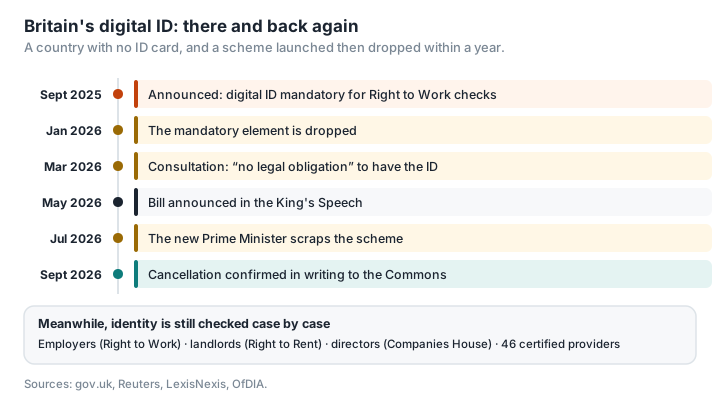
Political tradition, and two false starts: the wartime identity card was abolished in 1952, and the 2006 scheme was repealed by an Act of 2010, with cards already issued ceasing to be valid in early 2011 (legislation.gov.uk). Keir Starmer's government revived the idea in September 2025, in digital form: "Digital ID will be mandatory for Right to Work checks by the end of the Parliament" (gov.uk). A petition against it gathered nearly 3 million signatures (UK Parliament).
What followed was one climbdown after another. In January 2026, the government dropped the mandatory element (Reuters, via The Star). The consultation launched in March confirmed it: "There will be no legal obligation for people to have or present the digital ID" (gov.uk). In May, the King's Speech still announced a bill to set out its framework (gov.uk). But in July, Andy Burnham, newly elected Labour leader, succeeded Keir Starmer, and on 21 July his government announced that the programme was cancelled, its estimated £1.8 billion cost going towards a cut in VAT on household electricity (gov.uk). In September 2026, the government confirmed it in writing, in response to a Commons committee: the national digital ID programme will not go ahead, and employers will not be required to carry out all their Right to Work checks digitally (LexisNexis, Lisa's Law).
So who checks identity?
Just about everyone, case by case.
Employers must check every employee's right to work, on pain of a civil penalty of up to £60,000 per illegal worker; the scale starts at £45,000 for a first breach and rises to £60,000 for a repeat breach within three years (gov.uk, Home Office code of practice). Since 1 October 2026, the duty has extended to some workers who aren't employees: individual subcontractors and people who find work through a platform (gov.uk).
Landlords in England must check that every adult tenant has the right to rent, and must check everyone: checking only those you assume to be foreign nationals is unlawful (gov.uk).
Company directors now have to verify their identity with Companies House, as we explained in the previous episode.
For these checks, the state relies on certified digital identity providers, regulated since 2025 by the Data (Use and Access) Act. In July 2026, the register listed 46 providers offering 64 certified services (gov.uk). Using them remains optional for employers and landlords: a manual check of an original document, with a copy kept on file, is still allowed.
What does the data protection regulator say?
The ICO applies the UK GDPR's data minimisation principle: collect only the data you need. When handling a subject access request, an organisation must be "reasonable and proportionate" in what it asks for, and should only ask for ID where it's necessary (ICO). We found no ICO guidance dealing specifically with passport copies. Therein lies the paradox: the Right to Work rules require you to keep a copy of the document for the whole of the employment and for two years afterwards (gov.uk), while data protection law asks you to collect as little as possible.
France lives with the same tension, with one difference: it has a national identity card, though holding one isn't compulsory, and the French state recommends watermarking any copies you send (see Watermarking your ID document).
And e-invoicing?
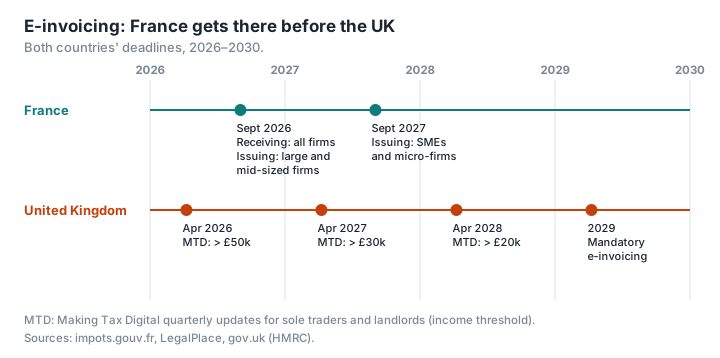
Here the UK is behind France. In November 2025, the government announced that "the UK will introduce mandatory e-invoicing for all VAT invoices from 2029" (gov.uk). Businesses that aren't VAT-registered are out of scope, the model will be decentralised, with no government platform, and real-time reporting of data to HMRC isn't planned for that date. In June 2026, the government confirmed that Peppol would be the UK's central network for exchanging e-invoices (gov.uk). The exact format, and any phasing by business size, have yet to be set.
Meanwhile, under Making Tax Digital, sole traders and landlords with combined trading and property income above £50,000 have, since April 2026, had to keep their records in software and send an update every quarter; the threshold drops to £30,000 in 2027 and to £20,000 in 2028 (gov.uk). More than 860,000 sole traders and landlords were in scope from the first year (gov.uk), and by August 2026 more than 436,000 had filed their first quarterly update (gov.uk).
In France, every business has had to be able to receive e-invoices since 1 September 2026, and SMEs will have to issue them from September 2027, with invoice data passed to the tax authorities (see Your first invoice in France). On this point, France is roughly two years ahead.
What can a business owner take from this?
An identity check leaves copies behind. Whether it's an employer, a landlord, a bank or a verification provider, every check can produce a copy stored somewhere else. In the UK, the lack of a national card has multiplied these one-off checks; in France they exist too, for a bank account or a registered office address (see Opening a business bank account in France without sending everything).
Prefer a check to a copy where you can. A check via an app, in person or through a certified provider passes on a result; a photocopy passes on everything, for a long time. When a copy can't be avoided, you can cut it down to what's needed and mark it for its recipient: Redact PDF removes the areas you choose (the page is rebuilt as an image, with no recoverable text), Watermark PDF stamps the text of your choice diagonally across it, for instance the recipient's name and the purpose, both in your browser; a phone photo of a document can be turned into a PDF first with JPG to PDF. A word of caution: some recipients, a bank for instance, need to see the whole document; only hide what isn't required.
PDFKami doesn't verify identity and is no substitute for a certified provider; it's for preparing the copies you have to send without uploading them to a third-party service.
Glossary
Right to Work: the UK employer's duty to check that a worker is allowed to work in the UK.
Right to Rent: the duty on landlords in England to check that a tenant is allowed to rent a home there.
ICO (Information Commissioner's Office): the UK data protection regulator; its French counterpart is the CNIL.
Making Tax Digital: HMRC's programme requiring sole traders and landlords to keep digital records and send quarterly updates.
Peppol: an international network, European in origin, for exchanging e-invoices between businesses and public bodies.
Prepare a copy of an identity document without uploading it: PDFKami, in your browser.