
Rent a flat in France, take out a loan, apply for a benefit or a nursery place, and sooner or later you'll be asked for your latest avis d'impôt sur le revenu, usually just called the avis d'imposition: the annual income-tax notice sent out by the DGFiP, France's tax authority. This article is about that French document. It concerns you if you live or rent in France, if you're an expat or a cross-border worker who pays tax there, or if you're a student applying for a flat or a grant in France and you're asked for a French tax notice.
The notice runs to several pages and gives a lot away: your income in detail, your family situation, any dependent children, your tax number (numéro fiscal) and sometimes your bank account. The cautious reflex, redacting whatever isn't needed, runs into a particular problem here: the recipient has to be able to check that the notice is genuine. And what makes that check possible is precisely your tax number and the notice reference (référence de l'avis).
What's on a French tax notice?
According to impots.gouv.fr, the French tax authority's website, the notice sums up all the income you declared, the number of parts (the household's tax shares under the quotient familial, the French system that adjusts tax to the size of the family), the revenu fiscal de référence (RFR, a reference income figure), the date de mise en recouvrement (the date from which the tax can be collected) and the payment deadline, the balance due and the direct-debit schedule; a 2D-Doc code is printed on the first page. Since 2026, the notice has been available only online, in your personal account on impots.gouv.fr or in the app, unless you asked for a paper copy (impots.gouv.fr). In more detail:
- the first page carries the "Vos références" (your references) box, with the tax number of each person filing and the notice reference, your address, the revenu fiscal de référence and the number of parts, and, if you're due a refund, the details of the bank account it will be paid into (impots.gouv.fr, Toutsurmesfinances);
- the following pages set out who makes up the household, your family situation, dependent children, each filer's income, deductible expenses, tax reductions and credits, and then the tax rates (Toutsurmesfinances).
The revenu fiscal de référence is the figure that many kinds of help are based on: housing assistance, benefits from the CAF (France's family-benefits office) and legal aid (LegalPlace).
Who can ask you for it?
For a rental, the list of documents a landlord may ask for is set by a 2015 decree (Decree no. 2015-1437 of 5 November 2015): the applicant can provide their latest or second-to-last tax notice (called an avis de non-imposition if no tax was due), and a copy is enough, though the landlord may ask to see the original. The landlord can't demand any document that isn't on that list, on pain of an administrative fine, imposed by the prefect (the State's representative in each département), of up to €3,000 for an individual and €15,000 for a legal entity, such as a company (service-public.gouv.fr, ANIL, LegalPlace). In particular, a landlord can't ask for bank statements, as CNIL, France's data protection authority, points out (CNIL).
Banks, government departments and social-security bodies ask for it too, to assess how much you can borrow or whether you're entitled to a benefit (service-public.gouv.fr). For a nursery place, school meals or some local social support, though, local authorities connected to the DGFiP's "API Impôt particulier", a secure link that lets them query the tax authority directly, can fetch your revenu fiscal de référence and number of parts themselves, without you supplying the document (collectivites-locales.gouv.fr). Ask before you send the notice.
What about where you are? In the UK, the documents usually asked for as proof of income are the P60, the end-of-year certificate your employer must give you, which GOV.UK says you may need "as proof of your income if you apply for a loan or a mortgage", and, if you're self-employed, the SA302 tax calculation and the tax year overview, which you can print from your HMRC online account and may be asked for when you apply for a mortgage (GOV.UK, GOV.UK). The identifiers to watch on HMRC paperwork are your National Insurance number, which employers must show on the P60 and which GOV.UK says not to share "with anyone who does not need it", and your Unique Taxpayer Reference (UTR), a 10-digit number found on tax returns and other HMRC documents (HMRC, GOV.UK, GOV.UK). We haven't found an official list for England like the French decree; Citizens Advice says landlords and letting agents may ask for references, bank statements to show your income (cover the account numbers, it advises) or, if you're self-employed, your trading accounts and an accountant's reference (Citizens Advice). These are pointers, not a guide: for your own situation, check GOV.UK, HMRC or Citizens Advice.
How does the recipient check it's genuine?
This is the heart of the problem. The French tax authority offers two checks that complement each other, and both rely on your tax number and the notice reference.
The online verification service. Free and open to anyone on impots.gouv.fr (under "Vérifier un avis d'impôt", check a tax notice), the service, known in France by its acronym SVAIR, asks for the tax number (13 digits) and the notice reference (13 characters, letters and numbers), both found in the "Vos références" box. It answers only "conforme" or "non conforme": either the notice matches the latest one the tax authority holds for that household, or it doesn't (impots.gouv.fr, verification service). In its version before 2023, it also displayed some of the notice's data, including family situation, number of parts, gross total income, taxable income and the amount of tax, as a ruling by the Conseil d'État, France's highest administrative court, describes (Conseil d'État). That has no longer been the case since April 2023 (DGFiP): on their own, these two references no longer give access to your tax data.
The 2D-Doc code. This square barcode, printed on the first page of tax notices since April 2022, is a signed electronic seal in a format designed by France Titres (formerly ANTS, the French state agency for secure documents such as passports and driving licences). It can be read with a free app and proves that the document hasn't been altered, but not that it's the latest notice: that's what the online service is for. It contains, in plain text, the names of the people filing, the income year, the date de mise en recouvrement, the number of parts, the revenu fiscal de référence, the tax number and the notice reference (economie.gouv.fr). The check consists of comparing this data with what's printed on the notice (DGFiP): hide any one of those fields and the comparison can't be made.
These are the two checks that the ADIL for the Indre département, one of France's local housing-information agencies, presents to landlords (ADIL 36).
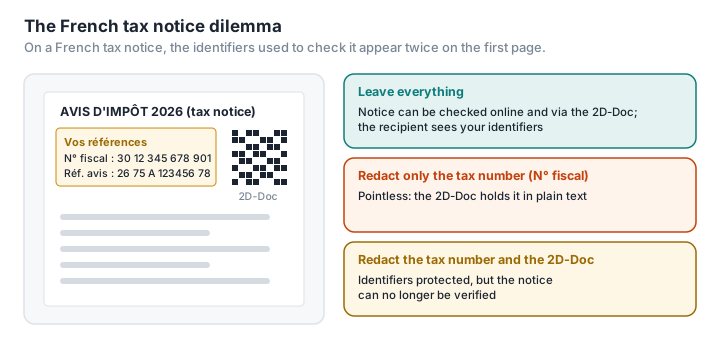
The trap: redacting the tax number… but not the 2D-Doc
Many people black out the tax number in the "Vos références" box, thinking it protects them. But if the 2D-Doc stays visible, any reader app will give it back in plain text. The redaction is then pointless, and on top of that it gets in the way of checking the 2D-Doc, which compares the decoded number with the printed one.
Conversely, redacting both references and the 2D-Doc protects those identifiers but stops the recipient checking the notice. To a landlord, a notice that can't be verified is a suspect notice, all the more so since fake tax notices are a classic of rental fraud. DossierFacile, the French state's free rental-application service, for instance, rejects incomplete notices (DossierFacile); we go through what it requires in Renting in France: what DossierFacile asks for.
As far as we know, there's no official rule on partially redacting a tax notice. For the identifiers, then, the choice is binary: a notice that can be verified, or identifiers that are hidden. For most legitimate purposes, the first wins.
What's the risk in leaving your tax number visible?
Less than you might fear, more than you might think. To set up access to the espace Finances publiques on impots.gouv.fr (your personal online tax account, formerly called the espace particulier), you need your tax number and your revenu fiscal de référence, both on the notice, plus an online access number (numéro d'accès en ligne), which is printed on your tax return (déclaration de revenus), not on the notice, and changes every year (impots.gouv.fr). The notice alone won't open your account, then, and the verification service only answers "conforme" or "non conforme". The real risk lies in the notice as a whole, which feeds identity theft: Cybermalveillance.gouv.fr, the French government's support service for victims of cybercrime, lists the tax notice among the documents you shouldn't hand over to people or organisations whose identity you haven't confirmed for certain, and points out that an identity thief can open a bank account or take out credit in their victim's name (Cybermalveillance.gouv.fr). And summer 2026 was a reminder that tax data itself can leak: the DGFiP reported unauthorised access to its information systems, through which data (revenu fiscal de référence, quotient familial, and the rate of prélèvement à la source, France's pay-as-you-earn withholding) was extracted on 678,000 individuals and businesses (French Ministry of the Economy).
So what should you actually do?
1. Check the recipient is genuine before you send anything. It's the most effective protection: fake rental listings are also used to harvest personal documents, which are then reused, for instance, to take out credit in the victim's name, warns the INC, France's national consumer institute (INC). Don't send anything before you've viewed the property or checked the landlord's identity.
2. Send the whole notice to a legitimate recipient, rather than just the first page: no official source says the first page is enough, and an incomplete notice may be rejected.
3. Redact what's of no use to anyone. The refund bank account on the first page and the direct-debit schedule tell a landlord, or a bank checking your income, nothing they need. They're neither in the 2D-Doc nor among the identifiers the online service asks for, so hiding them doesn't prevent any check. That's our own deduction, not an official rule.
4. Watermark the copy with the recipient, the purpose and the date, as Cybermalveillance.gouv.fr recommends for documents used in identity theft (see Why you should watermark your ID card). A notice marked "For the rental application at X, October 2026" loses much of its value if it's reused elsewhere.
5. If you really must hide the tax number, hide the 2D-Doc too, and offer the recipient another way of checking the notice, for instance by showing them the full notice in person.
None of this involves sending the document to a third party. With PDFKami's Redact PDF, the areas you select are blacked out and the page is rebuilt from an image, so the hidden text can't be recovered, unlike with a black rectangle laid on top, as we explain in Fake redaction: the black box on your PDF hides nothing. One thing to watch: on the rebuilt page, the 2D-Doc stays readable until you black it out as well. Watermark PDF then adds the line naming the recipient, diagonally across every page: keep the opacity moderate, as a heavy watermark over the 2D-Doc can make it hard to read. Everything happens in your browser.
Glossary
Numéro fiscal (tax number): a 13-digit identifier given to every taxpayer in France.
Référence de l'avis (notice reference): a 13-character identifier (letters and numbers) unique to each tax notice.
Revenu fiscal de référence (RFR): the reference income figure used as the basis for many French benefits and exemptions.
2D-Doc: a signed square barcode, in a format designed by France Titres (formerly ANTS), that lets you check with an app that an official French document hasn't been altered.
Notice-verification service: the DGFiP's online service which, from the tax number and the notice reference, says whether a notice is "conforme", meaning it's the latest one the tax authority holds for that household.
Avis de situation déclarative (ASDIR): a statement issued at the end of the online tax return, which also carries a 2D-Doc. It isn't a tax notice and isn't accepted everywhere: DossierFacile, for one, rejects it.