Every September in France, at the rentrée — when the school and working year starts again — the same scene plays out: one viewing, ten applicants, and a rental application to send "tonight". The documents are all over the place — a tax notice as a PDF, downloaded payslips, a photo of an ID card, an employment contract scanned at an angle. And all of it is about to go to a letting agency you know nothing about, or to a private landlord you found through a listing. DossierFacile, the French state's free service for putting together an application to rent a home in France, was built for exactly this.
Here's what it asks for, what it does with your documents, and why the one step it doesn't do for you — preparing them — is best done on your own machine, not on a conversion site.
What DossierFacile is
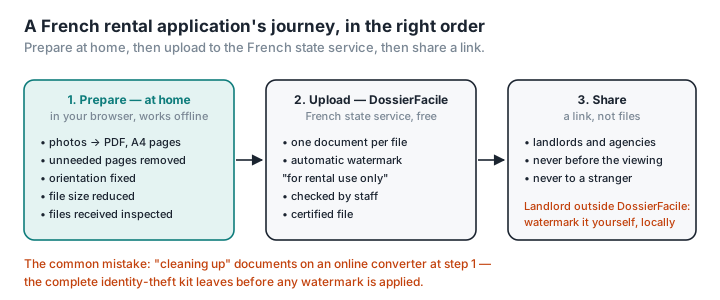
A free public service, run by the French ministry responsible for housing and incubated at beta.gouv.fr, the government's digital-services incubator, available at dossierfacile.logement.gouv.fr. You upload your documents; staff check them (legibility, consistency, completeness); the approved file gets a certification label and a link you send to landlords and letting agents, with no need to send the files again for every application.
Two things set it apart from plain file sharing:
- The automatic watermark. Every document you upload is stamped "destiné à la location immobilière exclusivement" (for rental use only) — the practice that gave rise to FiligraneFacile, the state's general-purpose watermarking service (DossierFacile). A document that has been through DossierFacile is useless for opening a bank account or taking out a loan.
- Human checks. A certified file is one that a member of staff has judged compliant. For a landlord, that saves time; for you, it's an edge over applications thrown together in a hurry.
What it asks for
The core is the same as for any rental application in France, governed by a 2015 decree (Decree no. 2015-1437 of 5 November 2015) that sets an exhaustive list of what a landlord may ask for:
- Identity: a valid identity document, both sides.
- Current address: your last three rent receipts (quittances de loyer) if you rent, a letter from whoever is putting you up (attestation d'hébergement), or your latest property-tax notice if you own your home.
- Employment status: an employment contract or a letter from your employer, a student card, a Kbis extract (the French company-registration certificate), and so on.
- Income: your last three payslips, your latest avis d'imposition (the annual income-tax notice from the French tax authority), and proof of any other income.
- The same documents for each guarantor (garant) — the person who undertakes to pay the rent if you can't.
Each document is one file; each file must be legible in full, the right way up, and reasonably light.
If you're coming from abroad — for a job transfer, your studies or a fresh start — you can use DossierFacile too, but expect some translating. Its help pages say a foreign tax notice is accepted as long as it's translated into French, and a foreign payslip if it's understandable or comes with a signed statement explaining the pay (DossierFacile help: foreign tax notice, income). You don't need a sworn translator: you can translate the key points yourself, directly on the document, with amounts converted into euros — DossierFacile even suggests printing the documents, writing the translations in by hand and photographing them (DossierFacile help: simplified translation). That's the rule for every rental application in France, not a DossierFacile quirk: copies must be written in or translated into French, with amounts in euros, and a foreign ID card, passport or driving licence with a photo is accepted as proof of identity (service-public.gouv.fr).
No French tax notice yet? The form has a "no tax notice" option where you pick your situation (DossierFacile help). And a visa on its own isn't proof of identity: it has to come with your passport, as does a receipt for a first residence-permit application (DossierFacile help: residence permit).
The guarantor is often the sticking point. DossierFacile's own guide for international students is frank: some landlords accept a guarantor living abroad, but it's rare; it suggests Visale instead, or a bank guarantee — a sum deposited with a French bank as security (DossierFacile). A foreign guarantor's tax notice must be translated into French as well (DossierFacile help). Visale is a guarantee from Action Logement, a French housing body, which stands as your guarantor free of charge, covering unpaid rent and damage to the property. It's open to anyone aged 18 to 30 inclusive, whatever their situation, and to private-sector employees over 30 under certain conditions — for instance within six months of starting a job, or of a transfer within the same company or group. Students from outside the EU need a long-stay visa that serves as a residence permit marked "étudiant" (or a talent passport), or a student residence permit, and can't apply before the visa's start date; other non-EU applicants need a valid residence permit or a visa that serves as a work permit (Visale, under 30, over 30, eligibility by nationality). DossierFacile lists Visale among the guarantee organisations you can add to your file (DossierFacile help).
What about where you are? In England, the law works the other way round: before letting, a landlord must carry out a "right to rent" immigration check on every adult who will live in the property as their main home, whatever their nationality — through the Home Office's online service with a share code, by checking original documents, or through a certified identity-verification provider — and keep a copy securely for at least a year after the tenancy ends; the scheme covers England only (GOV.UK). A letting agent, or a landlord who runs credit checks or takes references on prospective tenants, has to pay the ICO's data protection fee, and UK GDPR requires personal data to be "adequate, relevant and limited to what is necessary" (ICO, ICO). We haven't found a UK government service that checks and certifies a tenant's file the way DossierFacile does. These are pointers, not a guide: for the rules where you rent, check GOV.UK, the ICO or your own country's authorities.
The step nobody does for you: preparation
DossierFacile checks and watermarks. It doesn't straighten a crooked photo, strip the unneeded pages out of a twenty-page contract, turn a screenshot into a clean PDF or shrink an 8 MB scan. A file rejected for an "illegible document" or an "incomplete document" goes back into the queue — days lost at the height of the season.
And this is where many people go wrong: to "clean up" their documents, they turn to the first online converter they find. The result: the ID card, the payslips and the tax notice — a complete identity-theft kit — are uploaded to a commercial site's servers before they reach the state's service, watermarked. All of DossierFacile's protection kicks in after the risk has already been taken.
Preparation should happen on your own machine. With PDFKami, everything runs in the browser, with nothing uploaded:
- Photos → PDF. ID card, photographed rent receipts: JPG to PDF, with the centred A4 pages option. One document per file.
- Extra pages. A fifteen-page employment contract when the agency only wants the first and last pages: Delete pages. Send less, and you expose less.
- Orientation. An upside-down page is a common reason for rejection: Rotate PDF.
- Size. A heavy scan slows everything down and can exceed the limits: Compress PDF, medium level.
- Combining, only if the recipient asks for it: Merge PDF. DossierFacile prefers one document per file.
- Inspection, if a document comes from someone else (a certificate received by e-mail): Inspect PDF before adding it.
You can do all of this in flight mode. Nothing leaves your machine until you decide to upload to DossierFacile.
And when the landlord won't use DossierFacile
It happens: an agency with its own portal, a private landlord who wants "the PDFs by e-mail". In that case DossierFacile no longer protects you, and the watermark becomes your job. Apply it yourself, locally, with Watermark PDF — purpose, recipient, date — on every document, before sending anything. We explain what to write and why in Why you should watermark your ID card.
And two rules DossierFacile itself stresses: never send your documents to someone whose identity you aren't sure of, and be wary of too-good-to-be-true listings that ask for your file before the viewing — it's the identity thieves' favourite way of collecting them (beta.gouv.fr).