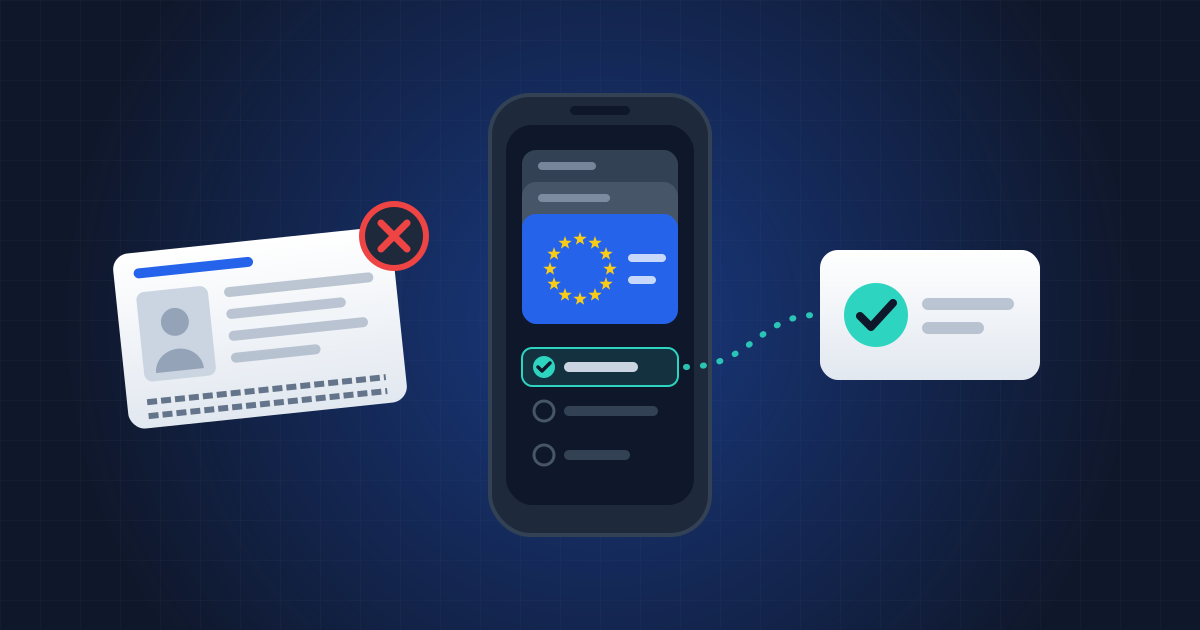
Renting a flat, opening a bank account, checking into a hotel, joining a gym: in 2026, we're still sending photos of our ID card or passport. Each copy lands in an inbox, a shared folder or a server, and stays there. Every so often a leak shows where those copies end up: in 2025, tens of thousands of scanned passports and identity cards were stolen from around ten hotels in Italy (Clubic).
The European Union has an answer on the way: the European Digital Identity Wallet, or EUDI Wallet. Every member state must offer one by the end of 2026. Will it put an end to ID scans? Partly, and not straight away. One thing first for readers in Britain: the UK is no longer in the EU, so these rules don't bind it. It's going its own way, which we come back to below.
What is the EU digital identity wallet?
It's a smartphone app that holds digital attestations signed by public authorities: your identity, your driving licence and, eventually, diplomas or social security entitlements. It's provided for by the EU's eIDAS 2 regulation, adopted in April 2024 (EUR-Lex).
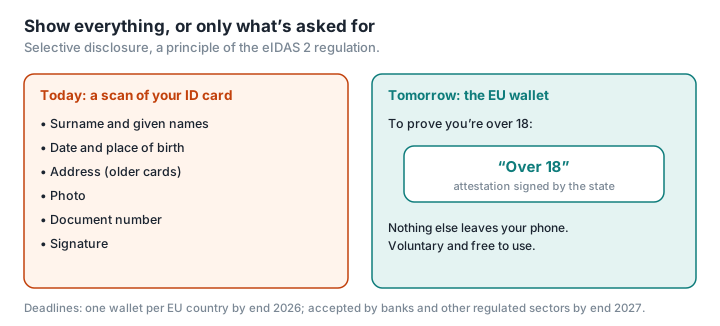
Its main promise comes down to two words: selective disclosure. Instead of sending your whole ID card, you pass on only the information that's been asked for ("I'm over 18", "I live at this address"), signed by the authority that vouches for it. A website selling alcohol doesn't need to know your name, or even your date of birth: only that you're of age. The regulation makes selective disclosure a requirement, bars the wallet provider from collecting information about how the wallet is used beyond what's necessary, and provides that transactions can't be tracked or linked without the user's permission (EUR-Lex).
When is it coming?
The timetable follows from the regulation's implementing acts, the first of which came into force on 24 December 2024 (EUR-Lex):
- end of 2026: every member state must provide at least one wallet to its citizens, residents and businesses within 24 months of those acts, which means by around 24 December 2026. The European Commission says the wallets are "set to launch at the end of 2026" (European Commission);
- end of 2027: 36 months after those same acts, private companies that are required by law or by contract to use strong authentication for their customers (banking and financial services, energy, telecoms, health, transport, education and so on) will have to accept it whenever a user asks to use it. Micro and small enterprises are exempt (EUR-Lex).
Online public services that require electronic identification will have to accept it too, as will very large online platforms that ask their users to log in (on request, and only for the data that's needed). The regulation sets no specific deadline for either of these obligations.
Using it will remain voluntary, and free for individuals: not using the wallet must not restrict anyone's access to public or private services, or put them at a disadvantage.
Where does France stand?
France gives a good idea of how far a member state has got. It starts from a solid base: France Identité, the French state's digital identity app, which has been designated as France's future digital wallet (France Identité). On 1 October 2026, France's Interior Ministry reported more than 5 million users, with 1.7 million digital driving licences, over a million vehicle registration certificates (cartes grises) and over a million digital cartes Vitale (France's health insurance card) activated in the app (French Interior Ministry). France Titres (formerly ANTS, the agency that issues France's secure documents), which runs the app, is coordinating two of the European pilot projects, POTENTIAL and then APTITUDE (France Identité), and France is among the first countries to test the age-verification app put forward by the European Commission (European Commission).
The French timetable is still hazy, though. The ministry hasn't announced a launch date for the European wallet itself. Goodflag, a French e-signature company and one of the signatories of a memorandum of understanding concluded with France Titres on 5 February 2026, talks of an "official launch" some time in 2027 (Goodflag). According to an independent tracker, no wallet had yet received European certification by early October, France Identité included (openideurope.eu).
What about where you are? The UK has left the EU and isn't bound by eIDAS 2, and the national digital ID it announced in September 2025, at first meant to become mandatory for right-to-work checks, was cancelled on 21 July 2026; employers can verify a new hire's identity through a certified digital provider on the government's register, but they don't have to (GOV.UK, GOV.UK, Home Office). GOV.UK Wallet, the government's app for official documents, isn't open to the public yet: for now, only the HM Armed Forces Veteran Card can be saved to a phone, with the driving licence promised "in future" (GOV.UK). Closer to the idea of selective disclosure, since 15 September 2026 pubs, shops and venues in England and Wales can choose to accept a certified app that simply confirms you're over 18, without your name or address (GOV.UK). In Ireland, which is in the EU, the government launched a public consultation and opt-in testing of its Government Digital Wallet in April 2026, to meet the end-2026 deadline (gov.ie).
Can you already avoid sending a scan?
In France, yes, in some cases. Since 2024, France Identité has let users generate a single-use proof of identity (justificatif d'identité à usage unique): a document signed by the Interior Ministry, for which you choose the recipient, how long it stays valid and, optionally, the purpose (service-public.fr). More than a million have been generated so far (French Interior Ministry). The recipient is free to accept it or not. You need to be 18 or over, to hold the new credit-card-format French ID card, issued since 2021, and to have a compatible smartphone (France Identité).
Does the wallet solve everything?
No, for three reasons.
Not everyone will have it. In France, it requires the new ID card and a compatible smartphone. Five million users is a lot, but it's a long way from the whole population.
Not everyone will accept it. The 2027 obligation targets specific sectors. Private landlords, small hotels, clubs and charities, and employers aren't covered, and will keep asking for copies. Even where it does apply, the wallet sits alongside the other methods rather than replacing them: a bank will still be able to ask anyone who doesn't use it for a photo of their ID and a selfie.
Privacy is still up for debate. In 2025, Spain's data protection authority pointed out that the attestation formats under consideration rely on signatures that make it possible to link together separate presentations of the same attestation (AEPD). In March 2026, around ten digital rights and consumer organisations, including EDRi and the Chaos Computer Club, published an open letter arguing that the draft implementing rules weakened the safeguards against tracking (epicenter.works).
What can you do in the meantime?
Until the wallet is available and widely accepted, the usual precautions still apply.
Hand over only what's required. In France, for example, the documents a landlord may ask a prospective tenant for are set by decree: a single proof of identity, and no bank statements, carte Vitale or livret de famille (the family record book French couples are given when they marry or have a child), on pain of a fine (service-public.fr, CNIL, LegalPlace). That's the GDPR's data minimisation principle at work: collect only the "strict minimum" (LegalPlace). We go through French rental applications in detail in our DossierFacile guide.
Use France Identité's single-use proof if you have the app and the recipient accepts it.
Otherwise, watermark the copy with the recipient, the purpose and the date, as recommended by CNIL, France's data protection authority, and by Cybermalveillance.gouv.fr, the French government's cybercrime assistance service. The French public service FiligraneFacile does this online; PDFKami's Watermark PDF does it right in your browser, without uploading the document. We explain why in Why you should watermark your ID card.
Glossary
EUDI Wallet: the European Digital Identity Wallet, provided for by the eIDAS 2 regulation.
eIDAS 2: Regulation (EU) 2024/1183, which amends the 2014 eIDAS regulation on electronic identification and trust services.
Selective disclosure: the ability to pass on a single piece of information (age, address) instead of a whole document.
Attestation: a piece of digital information signed by an authority (identity, driving licence, diploma).
Single-use proof of identity: a PDF signed by France's Interior Ministry, generated in the France Identité app for a given recipient and period.
Data minimisation: the GDPR principle that only the data that's needed should be collected.